

Canadian Business "Shark" Kevin O’Leary Named Main Threat to Bitcoin on Its Path to $1M
- Kevin O’Leary named the condition for bitcoin to reach $1 million.
- Mr. Wonderful pointed to the quantum threat.
- In addition, he walked back his bet on Ethereum and shifted his focus to AI and energy.
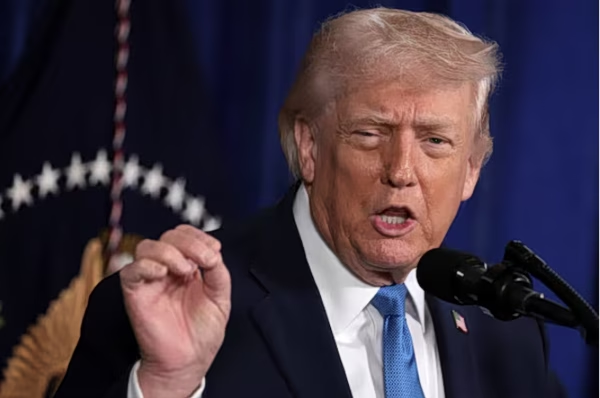
Canadian entrepreneur, investor, and TV host Kevin O’Leary (Mr. Wonderful from Shark Tank) said bitcoin could reach $1 million if the crypto industry can address the potential threat posed by quantum computers. He said this in an interview with The Rollup during the Avalanche Summit in New York.
THE KEVIN O’LEARY INTERVIEW.@kevinolearytv@robbieklages@andyyy
Timestamps:
— The Rollup (@therollupco) September 17, 2026
00:00 Intro
00:41 Kevin Wears $11M Ohtani Card
02:27 Tokenization Becomes The 12th S&P Sector
03:09 Kevin Was Wrong About ETH
05:30 One Exchange Will Win
07:18 Kevin Buys Uranium In His Portfolio… pic.twitter.com/xU0MhCvE68
At the same time, O’Leary stressed that he has reconsidered his previous bet on Ethereum and is now investing in energy infrastructure that is expected to power AI’s growth.
O’Leary No Longer Bets on Ethereum
According to the investor, 18 months ago his strategy was to buy bitcoin and Ethereum, as he expected the industry to standardize around Ethereum. However, in his view, that scenario did not materialize.
“People aren’t happy. Who’s next? What other chain is going to get adopted?” O’Leary said.
He now believes that different industries may choose separate blockchains depending on their needs. The investor also said he no longer sees Ethereum as the obvious candidate to serve as the base infrastructure for tokenization.
“I don’t think it’s going to be Ethereum anymore. I don’t think it’s fast enough. I don’t think it’s secure enough. That’s an opinion, my own opinion,” he noted.
O’Leary ties blockchain prospects to the development of tokenization for traditional assets. He called digital assets a separate infrastructure domain that could serve all 11 sectors of the S&P 500 index.

In his view, the blockchain that is first chosen by a major stock exchange for tokenization could see significant demand for its token, driven by the network’s use for subsequent transactions.
A Bet on AI Energy and the Q-Day Risk
On artificial intelligence, O’Leary said he does not want to guess which model will become the market leader. Instead, he is investing in the infrastructure required to run AI systems.
“You can’t do AI without power,” the investor said.
Among his investments are BitZero, a former bitcoin miner that has pivoted into an energy company, as well as private energy projects in Canada and the US. In addition, O’Leary opened a position in uranium for the first time in his investing career.
He said the development of small modular nuclear reactors could create additional demand for uranium to power data centers.
“You might as well buy the picks and shovels of that strategy,” he explained.
Separately, O’Leary commented on the future price of the first cryptocurrency. He linked a potential rise to $1 million to solving the problem of quantum computers, which could theoretically break the cryptographic algorithms that secure the network in the future.
“It [the price] will if it can resolve the doubt creeping in around quantum computing, you know, breaking the algorithms and the chain and the encryption,” O’Leary said.
This refers to the so-called Q-Day — the moment when a quantum computer becomes powerful enough to break public-key cryptography. No such systems exist today, and estimates for when the required technology might emerge vary widely — from the early 2030s to scenarios in which such an attack never becomes practical.
O’Leary also noted that some investors are already looking at companies developing quantum technologies as a potential hedge against this risk.
On US crypto regulation, the investor said he does not expect the CLARITY Act to be passed before the US midterm elections. In his view, after the elections, the bill could be revisited on a bipartisan basis.

Content Original Link:
" target="_blank">