

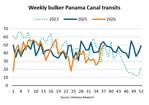
"Since the start of July, Panama Canal bulker transits have fallen 22% y/y. Bulkers have faced increased competition for transit slots from other sectors, especially tankers, as the US has boosted energy
"Since the start of July, Panama Canal bulker transits have fallen 22% y/y. Bulkers have faced increased competition for transit slots from other sectors, especially tankers, as the US has boosted energy exports to Asia. El Niño is also expected to lead to lower water levels, which mean transit restrictions and thus heightened competition for available capacity,” says Filipe Gouveia, Shipping Analysis Manager at BIMCO.
The canal is commonly used on trade routes between the east and west coasts of the Americas, as well as some routes between the Americas and East Asia or Europe. It is particularly important for the US, which is the origin or destination of 54% of dry bulk cargoes transported through the waterway. Grains, steel, fertilisers, coal, salt and petcoke are the main dry bulk commodities transported via the canal. These commodities are transported primarily by supramax, handysize and panamax ships.
“The decline in bulker Panama Canal transits has resulted in rerouting via the Cape of Good Hope or Cape Horn. The diversions increase average sailing distances and boost tonne mile demand. During the previous El Niño in 2023-24, when bulker transits decreased significantly, rerouting increased global dry bulk tonne-mile demand by around 1%,” says
Content Original Link:
" target="_blank">