

Europe dominates global container fleet capacity

While Asia remains the undisputed engine of global manufacturing, port throughput, and shipbuilding, it is European carriers that control the actual vessels moving those goods. Consequently, Europe dominates the global container fleet capacity, holding over 55% of the market with only a handful of mega-operators. This concentration of vessel ownership reveals a stark reality. Specifically, while the physical goods originate in the East, the logistical strings are largely pulled from the West.
According to the latest tracking data from Alphaliner, analyzing these operators reveals how container fleet capacity is geographically distributed. Therefore, we can easily highlight the key players driving maritime trade across each continent.
Europe: The Epicenter of Global Capacity
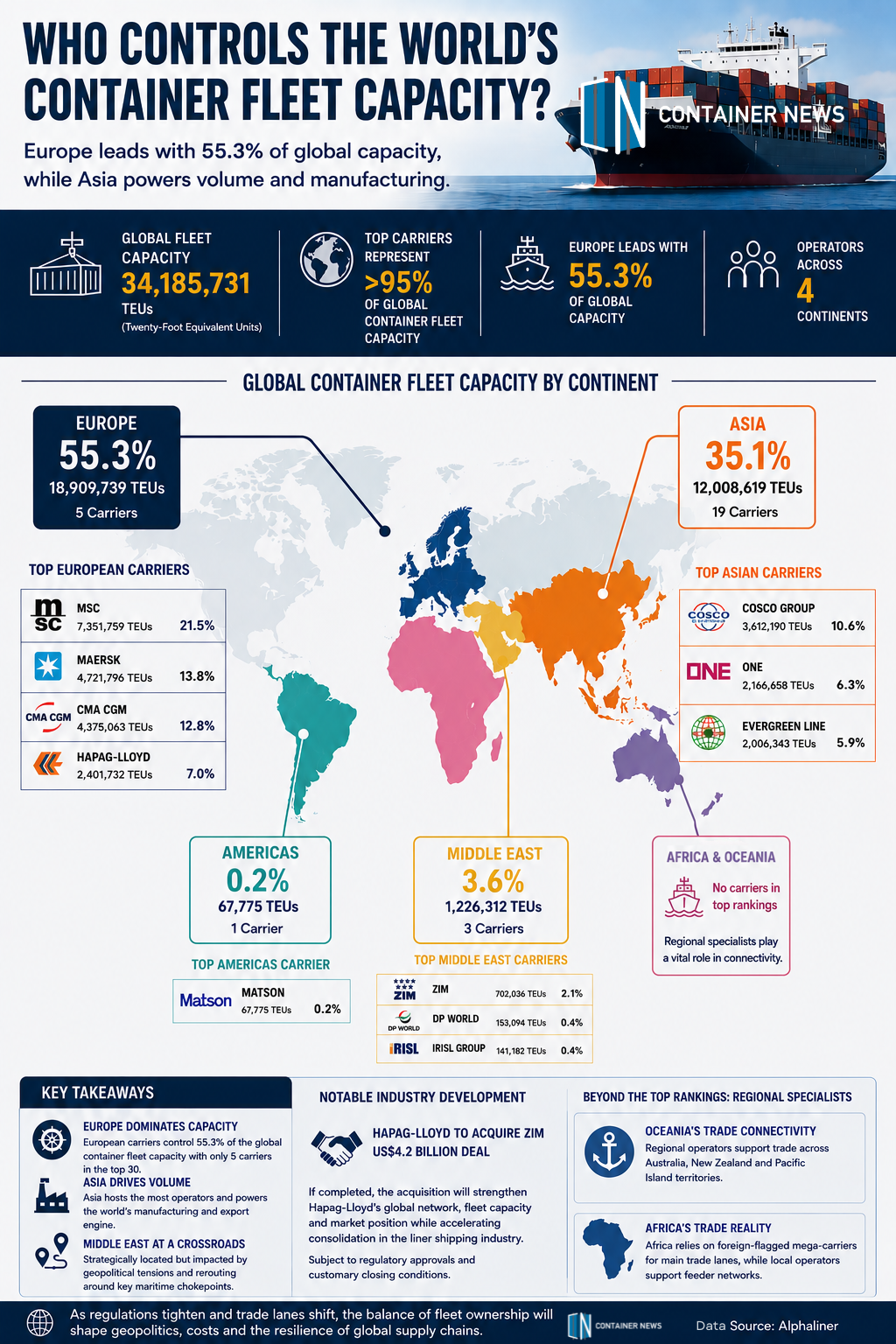
Europe commands a staggering 55.3% of the entire global market, despite having only five carriers represented in the top 30. This represents a massive concentration of power. Indeed, this footprint totals over 18.9 million TEUs (Twenty-Foot Equivalent Units) in fleet capacity.
European carriers have long championed the strategy of massive scale and global alliances. As a result, they secure their position at the pinnacle of ocean freight.
-
Mediterranean Shipping Company (MSC): Headquartered in Switzerland, MSC stands as the undisputed titan of the seas. Specifically, the carrier controls a massive 7,351,759 TEUs. This translates to a commanding 21.5% share of the total market. Thus, MSC continues to aggressively expand its fleet.
-
Maersk: The Danish shipping pioneer maintains its position as a cornerstone of global trade. Currently, it controls 13.8% of global capacity with over 4.7 million TEUs.
-
CMA CGM Group: Representing France, this carrier holds a 12.8% global market share. Consequently, it solidifies its presence on major east-west corridors with 4,375,063 TEUs.
-
Hapag-Lloyd: Operating out of Germany, Hapag-Lloyd secures 7.0% of the global market with 2,401,732 TEUs. In addition, it serves as a highly efficient, premium network operator.
Asia: The Engines of Manufacturing and Volume
Asia accounts for the largest number of individual operators in the top tier, with 19 carriers calling the region home. Together, they control 35.1% of the global market. Furthermore, this translates to over 12 million TEUs of active capacity.
Positioned at the heart of the world’s primary manufacturing hubs, Asian carriers leverage deep regional connectivity. Meanwhile, they maintain massive transpacific and Asia-Europe service loops.
-
COSCO Group: As China’s state-owned shipping giant, COSCO is Asia’s largest carrier. Currently, it commands 10.6% of the global market with a fleet exceeding 3.6 million TEUs.
-
ONE (Ocean Network Express): Formed via the integration of Japan’s major liner businesses, ONE is headquartered in Singapore. Today, it holds a 6.3% global market share with 2,166,858 TEUs.
-
Evergreen Line: Based in Taiwan, Evergreen remains a household name in ocean freight. For this reason, it successfully controls 5.9% of global capacity with 2,006,343 TEUs.
The Middle East: Strategic Gateways of the East-West Axis
Middle Eastern carriers account for 3.6% of the global market, with a cumulative fleet capacity of over 1.2 million TEUs.This region sits at the vital maritime crossroads between Europe and Asia. However, ongoing geopolitical tensions have heavily disrupted local trade routes.
Specifically, persistent security threats in the Red Sea, the Bab el-Mandeb, and the Strait of Hormuz force global carriers to reroute vessels around Africa. This major shift severely impacts transit times and operational costs.
-
Zim: Operating out of Israel, Zim represents a major portion of this regional footprint. Specifically, it holds a 2.1% global share with 702,036 TEUs as a highly agile niche and mainline operator.
-
DP World: Based in the United Arab Emirates, DP World continues to expand its asset-heavy carrier presence. Meanwhile, it operates a massive global terminal network and currently holds a 0.4% market share with 153,094 TEUs.
-
IRISL Group: The Islamic Republic of Iran Shipping Lines (IRISL) represents 0.4% of global capacity with 141,182 TEUs. Therefore, it successfully navigates key regional trade lanes.
Meanwhile, a massive corporate restructuring is redefining the region’s commercial footprint:
The proposed acquisition of ZIM by Hapag-Lloyd, valued at US$4.2 billion, represents one of the largest consolidation moves in the history of the container shipping industry. If completed, the transaction would significantly strengthen Hapag-Lloyd’s global network, fleet capacity and market position while further accelerating consolidation across the liner shipping sector.
The deal remains subject to regulatory approvals and customary closing conditions before it can be finalized, making its outcome one of the most closely watched developments in the maritime industry.
The Americas: Niche and Jones Act Dominance
The Americas hold a quiet presence in the top rankings. In fact, they represent just 0.2% of the global market with 67,775 TEUs inside the top 30.
-
Matson: Representing the United States, Matson is the sole carrier from the Americas in this top tier. It operates at a 0.2% global share. However, Matson plays a critical role in domestic Jones Act trade. Specifically, it services the U.S. West Coast, Hawaii, Alaska, and selective expedited transpacific routes.
Africa and Oceania: Regional Specialists vs. Global Giants
Neither continent claims a carrier in the immediate top carriers. However, a deeper dive reveals key local players that support regional connectivity. This proves that even niche operators hold vital spaces in the wider global market.
-
Neptune Pacific Direct Line (NPDL): With 9,783 TEUs, NPDL is a standout example of an Oceanian regional specialist. Formerly, legacy carriers operated independently in the South Pacific. Today, this integrated line acts as a critical lifeline linking Australia, New Zealand, Fiji, and various Pacific Island territories.
-
African Trade Dependence: Africa remains primarily reliant on foreign-flagged multinational giants to handle its main trade lanes. Although local operations handle feeder networks, foreign mega-carriers carry the continent’s primary imports and exports. This highlights the structural reality of globalized supply chains.
Outlook
As the maritime industry faces evolving environmental regulations and shifting trade lanes, the geographical distribution of container fleet capacity will continue to play a pivotal role in geopolitics and global supply chain resilience. Nevertheless, the power remains firmly concentrated in European and Asian waters.
The post Europe dominates global container fleet capacity appeared first on Container News.
Content Original Link:
" target="_blank">