


VesselBot finds wide gap between EU ETS surcharges and voyage exposure

The carbon exposure generated by individual container voyages can differ significantly from the standard EU ETS-related surcharges applied to shipments, according to a new VesselBot analysis.
The study examined more than 20,000 EU and EEA-linked container ship voyages completed during the second quarter of 2026.
These voyages generated 11.8 million tonnes of CO₂ equivalent emissions. Around 7.15 million tonnes, or 60%, required the surrender of emissions allowances under the EU Emissions Trading System.
Using an EU Allowance price of €80 per tonne, VesselBot estimated the fleet-wide carbon exposure at €572.4 million for the quarter.
Fleet-wide exposure reaches €13.4 per TEU
VesselBot estimated that the analysed voyages collectively carried 42.8 million TEU. This produced a blended EU ETS exposure of approximately €13.4 per TEU.
However, the company warned that this figure does not provide an accurate shipment-level benchmark. Containers can appear on several voyage legs as they move through a carrier’s network, resulting in the same cargo being counted more than once.
VesselBot therefore examined non-overlapping routes to produce a clearer comparison between voyage exposure and carrier surcharges.
CMA CGM routes examined
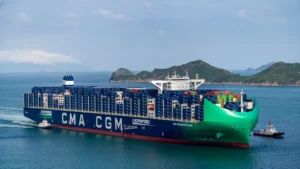
The analysis reviewed 58 CMA CGM-associated voyages from Singapore to Rotterdam, Valencia and Piraeus during the second quarter.
The voyages included:
- 31 sailings to Rotterdam
- 14 sailings to Valencia
- 13 sailings to Piraeus
Because Singapore is outside the EU and EEA, 50% of the emissions generated on direct voyages to the three European ports fell within the EU ETS.
| Route | Estimated ETS exposure | TEU carried | Exposure per TEU | Published surcharge |
|---|---|---|---|---|
| Singapore–Valencia | €5.30 million | 201,472 | €26.3 | €56 |
| Singapore–Piraeus | €7.60 million | 248,905 | €30.5 | €56 |
| Singapore–Rotterdam | €14.69 million | 523,266 | €28.1 | €70 |
The actual EU ETS exposure ranged from €26.3 to €30.5 per TEU. CMA CGM’s published Energy Transition Surcharge stood at €56 per TEU for Valencia and Piraeus and €70 per TEU for Rotterdam.
However, VesselBot stressed that the difference does not prove that the carrier is overcharging customers. CMA CGM’s surcharge also incorporates FuelEU Maritime costs and other commercial assumptions that fall outside the study.
Routing changes the carbon calculation
The analysis also examined seven observed Singapore–Felixstowe–Zeebrugge voyage combinations.
As the United Kingdom is outside the EU ETS, emissions from Singapore to Felixstowe did not fall within the system. Only 50% of emissions from the much shorter Felixstowe–Zeebrugge leg required allowances.
The seven voyages produced a combined 89,949 tonnes of CO₂ equivalent emissions. However, only 451.1 tonnes, or 0.5%, fell within the EU ETS.
At €80 per allowance, the total exposure across the seven voyages reached approximately €36,100.
The estimated ETS liability for each Felixstowe–Zeebrugge voyage ranged from around €4,400 to €6,000. By comparison, a 100 TEU shipment subject to CMA CGM’s published €70-per-TEU surcharge would incur a charge of €7,000.
Again, VesselBot noted that the comparison does not demonstrate overcharging because the surcharge includes costs beyond the EU ETS. Instead, it highlights how routing decisions can materially alter the carbon exposure associated with an individual shipment.
“Right now, surcharges aren’t standardised or comparable. They differ by carrier, by name and by what’s bundled inside them. A transparent, consistent, real-time benchmarking mechanism fixes that for everyone. Carriers get a defensible basis to point to. Shippers get a way to check it. That holds whether we’re talking about a fuel surcharge or an EU ETS, Energy Transition, EMS or ESS line item,” said Constantine Komodromos, Founder and CEO of VesselBot.
VesselBot concluded that shipment execution data covering the vessel, route, port sequence, emissions, utilisation and applicable regulatory scope is necessary to assess whether the ETS component of a surcharge reflects the exposure generated by the underlying voyage.
The post VesselBot finds wide gap between EU ETS surcharges and voyage exposure appeared first on Container News.
Content Original Link:
" target="_blank">