


Interview with Karen Baert, CEO of Ammobia: What Will It Take to Scale Ammonia as a Marine Fuel?

Ammonia is increasingly emerging as one of the potential fuels for decarbonising deep-sea shipping, but moving from early projects to widespread commercial adoption will require progress across infrastructure, regulation, production costs and workforce readiness.
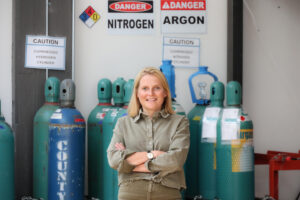
In an interview with Antonia Saratsopoulou, Managing Editor of Container News, Karen Baert, Co-Founder and CEO of Ammobia, discussed what still stands between ammonia and large-scale maritime adoption, whether sufficient supply can be developed, how production costs could fall and where ammonia could ultimately fit within shipping’s future fuel mix.
For Baert, the timeline facing the industry is significant. As she put it, 2050 is effectively “one ship lifetime away”, reflecting the long investment cycles involved in shipping and the time required for major changes across the fleet.
Four barriers still stand in the way
Baert identified four areas that need to progress before ammonia can move towards widespread adoption as a marine fuel: infrastructure, regulatory certainty, fuel costs and workforce readiness.
The first is infrastructure.
Ships need suitable engines and fuel-storage systems, while ports require infrastructure capable of supporting ammonia bunkering. Building that ecosystem will take time and investment.
The second challenge is regulatory uncertainty.
Baert said the expectation is that ammonia could become increasingly cost-effective over the long term. However, early adoption requires regulatory incentives to encourage first movers, while uncertainty around IMO and other regulatory measures can make it harder for companies to commit to major investments.
The third barrier is the price of clean ammonia, which today is higher than conventional marine fuels.
Finally, Baert highlighted workforce readiness. Ammonia itself is not new to shipping and has long been transported internationally as a commodity. Using it as a fuel in an engine room, however, creates different operational requirements.
Because ammonia needs to be handled carefully, she stressed the importance of adequately training the workforce that will work with the fuel.
Infrastructure, regulatory certainty, lower fuel costs and workforce preparedness therefore represent four critical pieces of the transition identified by Baert.
Can enough ammonia be produced for shipping?
Fuel availability remains an important consideration for shipowners contemplating ammonia-capable vessels.
Baert argues that ammonia has one important advantage: it is already produced at considerable scale.
She put today’s ammonia market at approximately 180–200 million tonnes per year, driven largely by demand from the fertiliser industry.
To illustrate the potential scale of maritime demand, Baert said that switching all deep-sea shipping from existing marine fuels to ammonia overnight would approximately double the size of the current ammonia market.
Such a transition would, of course, take place gradually.
Baert also said that a new ammonia facility producing around one million tonnes annually could, as an indicative comparison, provide enough fuel for approximately three to five large container ships.
For her, the larger question is therefore not whether additional ammonia plants can be built, but how supply can expand alongside maritime demand without creating a chicken-and-egg problem between producers and shipowners.
Bringing the cost of clean ammonia down
Cost remains central to ammonia’s prospects as a mainstream marine fuel.
Baert pointed to the difference in energy density between ammonia and conventional marine fuel. On a weight basis, she put ammonia at around 40% of the energy density, meaning more than twice the mass would be required to provide an equivalent amount of energy.
Using very low sulphur fuel oil at an illustrative price of around US$1,000 per tonne, Baert said ammonia would need to reach roughly US$400 per tonne on this simplified energy-equivalent comparison.
She acknowledged that reaching that level would be challenging.
According to Baert, competitive clean-ammonia prices today are around US$600–800 per tonne, meaning significant further reductions would be required.
Several factors could contribute.
For green ammonia, electricity prices are particularly important, making locations with low-cost renewable power more attractive. Electrolyser costs are another factor, with Baert expecting these to decline as deployment increases.
Ammobia is targeting the ammonia production process itself.
The company is developing modular, low-pressure ammonia production technology which, according to Baert, has the potential to reduce the cost of the ammonia production plant itself by approximately twofold.
She said additional savings could come from lower logistics costs and improved integration with hydrogen production.
Combined, Baert estimated these factors could reduce ammonia production costs by around 10–30%, contributing towards the broader cost reductions needed to narrow the gap with conventional marine fuels.
These are Ammobia’s expectations for its technology and development pathway rather than demonstrated industry-wide cost reductions.
Could ammonia production move closer to ports?
Traditional ammonia production is concentrated in large industrial facilities, often located close to major sources of natural gas or coal.
Baert described the existing production model as highly inflexible in terms of location, scale and development time.
Conventional ammonia production operates at high temperatures and pressures and is typically developed at very large scale. Baert said new facilities can take around 10 years to develop.
Ammobia’s proposed modular, low-pressure approach is intended to provide greater flexibility.
According to Baert, the technology could enable a new plant to become operational in around three years rather than 10 and support cost-effective production beginning at approximately 100 MW rather than requiring gigawatt-scale facilities.
This enables cost-effective ammonia production from different types of hydrogen, including renewable hydrogen.
This flexibility could have implications for maritime fuel supply.
Baert said ammonia could potentially be produced closer to ports and bunkering demand where suitable low-cost energy is available, reducing the need to transport the molecule over long distances from major production centres.
She stressed, however, that this does not mean production would be viable at every port. Competitive energy and suitable feedstock would remain essential.
Where those conditions coincide with maritime demand, Baert believes more localised production could shorten supply chains and support more reliable, lower-cost ammonia supply.
Breaking the chicken-and-egg problem
A central challenge is deciding who takes the initial investment risk.
Fuel producers need confidence that demand will materialise before investing in new capacity. At the same time, shipowners need confidence that ammonia will be available before committing to ammonia-fuelled tonnage.
Baert sees strategic consortia as one possible answer.
Rather than asking a single company to absorb the risk, she suggested bringing together participants from different parts of the value chain, including producers and ammonia users, allowing them to share both the risk and potential upside of early projects.
Government support could also help get those initial investments off the ground.
Baert stressed that the transition ultimately needs to become economically viable without regulatory incentives. However, first-of-a-kind projects are typically more expensive, and she believes measures such as tax credits or subsidies can help incentivise early movers.
Dual-fuel vessels provide another way to reduce risk.
Ships capable of operating on ammonia and a conventional fuel give owners greater flexibility during the transition. If ammonia is unavailable or too expensive at a particular port, the vessel can use the alternative fuel.
That flexibility, according to Baert, helps decouple investment in ammonia-capable vessels from the need to establish a complete bunkering network immediately.
Ammobia targets commercial-scale deployment before 2030
Ammobia is also working to move its technology towards commercial deployment through a joint development agreement with Lummus Technology.
Baert said the partnership combines Ammobia’s focus on technology innovation with Lummus’ engineering and commercialisation capabilities.
The first milestone is the development of a full commercial technology package.
This would be followed by a first-of-a-kind commercial Ammobia system with a customer, expected to operate initially at around 1-10 tonnes per day.
The next stage would involve moving to full commercial scale, which Baert defined as approximately 50–500 tonnes per day.
Ammobia’s goal is to reach this stage before the end of the decade.
Where could ammonia fit in shipping’s future fuel mix?
Baert does not expect a single technology to dominate every segment of maritime transport.
Instead, she expects different fuels and technologies to serve different vessel types and operating profiles.
For ammonia, she described a potential three-phase transition.
The first phase, which she believes is now beginning, would see ammonia used on selected shipping routes and corridors where fuel is available at the required locations.
A second phase could involve broader adoption among gas carriers, particularly where vessels are themselves transporting ammonia and can benefit from related synergies.
In a third phase, Baert sees ammonia expanding more broadly into deep-sea shipping, including container vessels.
For shorter distances and smaller ships, she believes electrification, hydrogen or other alternatives may be better suited.
Ammonia, in her view, has particularly strong potential for long-distance deep-sea operations.
Baert was careful not to predict precisely how the future marine fuel mix will develop. However, she believes ammonia will become a major part of a broader mix of technologies and fuels used to decarbonise shipping.
The pathway remains complex. Production capacity must expand, costs need to decline, infrastructure must develop, regulatory uncertainty needs to be addressed and crews must be prepared to work safely with the fuel.
But for Baert, these challenges do not make large-scale ammonia adoption impossible. Instead, they underline the need for production, shipping demand, investment and policy to advance together as the industry works towards its long-term decarbonisation targets.
The post Interview with Karen Baert, CEO of Ammobia: What Will It Take to Scale Ammonia as a Marine Fuel? appeared first on Container News.
Content Original Link:
" target="_blank">