

Interview with Ivan Jiménez, Port of Bilbao President: Reliability Is the New Competitive Advantage

Reliability is becoming a key competitive factor for ports as global supply chains face growing uncertainty.
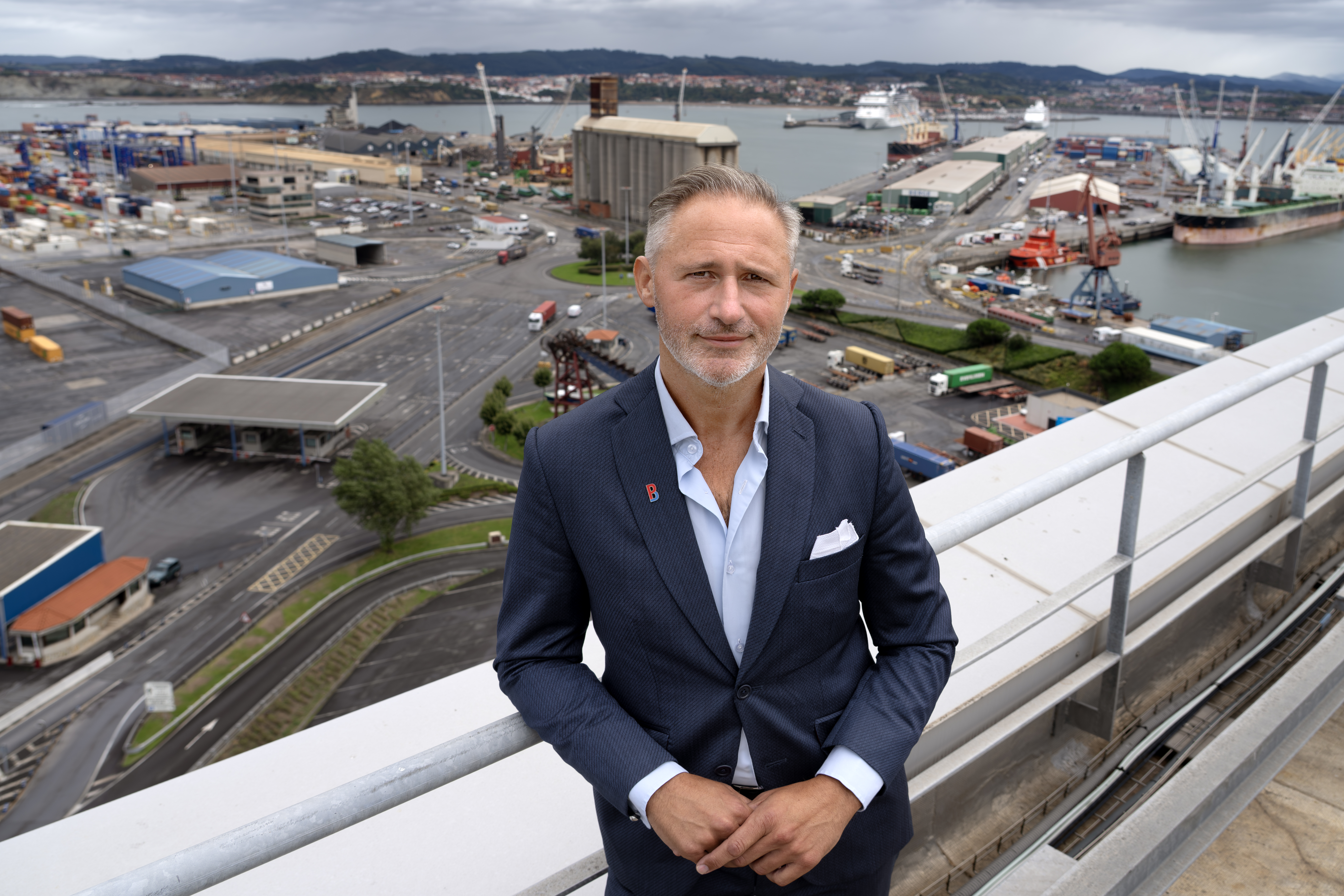
That is the view of Ivan Jiménez, President of the Port of Bilbao, who sees resilience, connectivity and decarbonisation as central to the port’s long-term strategy.
In the latest episode of CN Talks, Antonia Saratsopoulou, Managing Editor of Container News, spoke with Jiménez about Bilbao’s recent growth and future plans.
The discussion covered container connectivity, rail development, port electrification and digitalisation. It also explored how Bilbao is preparing for geopolitical and climate-related disruption.
According to Jiménez, the port has recorded its strongest start to a year in 22 years. Growth in liquid bulk traffic and containers has supported this performance.
Container growth and greater diversification
Higher liquid bulk volumes have been one of the drivers of Bilbao’s recent performance.
Jiménez noted that much of the oil and gas arriving at the port comes from North and South America. Key origins include the United States, Mexico and Brazil.
Container traffic has also performed strongly.
According to Jiménez, Spanish ports were averaging a 1.55% decline in container traffic measured in tonnes at the time of the interview. In contrast, Bilbao was recording growth of more than 4.5%.
New services and connections have contributed to that performance. In particular, Jiménez highlighted Canada and the Pacific coast of South America.
Therefore, diversification remains an important part of Bilbao’s strategy.
Asia is another major area of focus.
Jiménez pointed to increasing cargo flows from China. He also highlighted India as a market with significant potential.
As a result, improving connections with China and other Asian markets is one of Bilbao’s main connectivity objectives.
For Jiménez, however, port development is not only about physical capacity.
“We need to multiply every square metre of the port with the connectivity that we create around it,” he said.
Reliability becomes a competitive advantage
Bilbao’s strategy is not simply based on adding more services or competing on price.
Instead, Jiménez believes reliability is becoming increasingly valuable to shipping lines.
Congestion has affected several Northern European and Mediterranean ports. At the same time, geopolitical uncertainty continues to disrupt global supply chains.
Against this backdrop, Bilbao sees an opportunity.
“We know that probably we are not the cheapest port in the area, but we offer this reliability to the different lines,” Jiménez said.
Supply-chain planning has also changed.
Companies increasingly need to prepare for situations where operations do not develop as expected. Jiménez described this uncertainty as part of the “new normality” for shipping and logistics.
Consequently, Bilbao is focusing on its long-term position rather than reacting to short-term market movements.
“We don’t play in the short term,” he said.
Jiménez also noted that cargo has increasingly shifted towards Mediterranean corridors in recent years. Nevertheless, Bilbao has continued to grow above the average of Spain’s Atlantic corridor ports.
Rail supports Bilbao’s hinterland strategy
Hinterland connectivity is another important part of Bilbao’s plans.
Around 26% of the port’s container traffic currently moves by rail, according to Jiménez.
Moreover, the port wants to increase the role of rail in the future.
Several factors support this strategy. Decarbonisation is one of them, while the shortage of truck drivers is another.
However, Jiménez stressed that sustainability goes beyond emissions.
Bilbao’s approach combines economic, environmental and social sustainability. In this context, multimodal transport can support all three areas.
Meanwhile, work is progressing on new rail infrastructure.
Jiménez said the new infrastructure will connect with the high-speed rail network in the Basque Country. The project is expected to improve cargo connections while reducing transit times and emissions.
Bilbao advances shore power plans
Decarbonisation is also shaping investment inside the port.
Jiménez said Bilbao expects to have all its berths electrified by the end of 2027. He said this would put the port ahead of the 2030 European timeframe referenced during the interview.
The port already has its first shore power connection in operation as a test.
Another ten connections are planned, which would bring the total to 11.
According to Jiménez, shore power can significantly reduce emissions from vessels while they are berthed. This is particularly relevant for cruise ships because of their high energy requirements.
However, Bilbao’s energy strategy extends beyond shore power.
Jiménez believes ports will increasingly operate as energy hubs. Bilbao already has five wind turbines, while work on solar energy is also progressing.
The longer-term objective is to generate 25% of the port’s energy internally by 2032.
Furthermore, Jiménez linked local energy generation to resilience. Producing energy inside the port could reduce exposure to constraints affecting the traditional electricity network.
Therefore, he sees the energy transition as both an environmental and a competitive issue.
Digitalisation targets safer and more efficient operations
Technology forms another part of Bilbao’s strategy.
When asked about artificial intelligence, automation and advanced connectivity, Jiménez placed safety and security first.
For example, predictive systems could improve the maintenance of breakwaters and other infrastructure.
Such technology could help the port identify problems earlier. In turn, this could improve safety while reducing costs.
Digital connectivity could also improve coordination during port calls.
Jiménez highlighted interaction between vessels, mooring services, pilots and other parties involved in port operations.
Even relatively small efficiency gains can have an impact across the wider logistics chain.
As a result, Jiménez sees digital investment as another way for ports to improve their competitiveness.
Resilience and competitiveness go hand in hand
Ports are also facing a wider range of risks.
Climate events and geopolitical instability are making the operating environment more unpredictable.
Jiménez pointed to weather-related closures at Spanish ports as one example. In his view, ports need to prepare for disruption rather than simply react after it occurs.
Bilbao’s resilience strategy therefore covers several areas.
These include connectivity between port stakeholders, energy generation and distribution, multimodality and predictive technologies.
Together, these investments support both resilience and competitiveness.
“Competitiveness and resilience go hand in hand,” Jiménez said.
This relationship has become much more important in recent years. Moreover, tools that allow ports to anticipate disruption can create additional value for their customers.
Bilbao’s vision towards 2030
Looking towards 2030, Jiménez wants Bilbao to be recognised as a reliable European gateway.
Strong connectivity and multimodal transport will be central to that ambition.
At the same time, Bilbao aims to provide an alternative to congestion at major Central European hubs. The port also wants stronger direct connections with China and other Asian markets.
Finally, Jiménez believes decarbonisation should be viewed through the same competitive lens.
He acknowledged the debate surrounding Europe’s Emissions Trading System. He also noted the benefits of having common global regulation.
Nevertheless, his broader message was clear.
“Emissions and decarbonisation, we need to understand that as a tool of competitiveness and not as a problem,” Jiménez said.
For Bilbao, this approach connects many parts of its strategy. Rail, shore power, renewable energy, digitalisation and stronger connectivity all contribute to the same objective.
The aim is to build a port that can remain reliable, competitive and resilient as global trade becomes increasingly unpredictable.
The post Interview with Ivan Jiménez, Port of Bilbao President: Reliability Is the New Competitive Advantage appeared first on Container News.
Content Original Link:
" target="_blank">