


Crew Welfare Week 2026: Operational excellence and crew welfare are not competing priorities
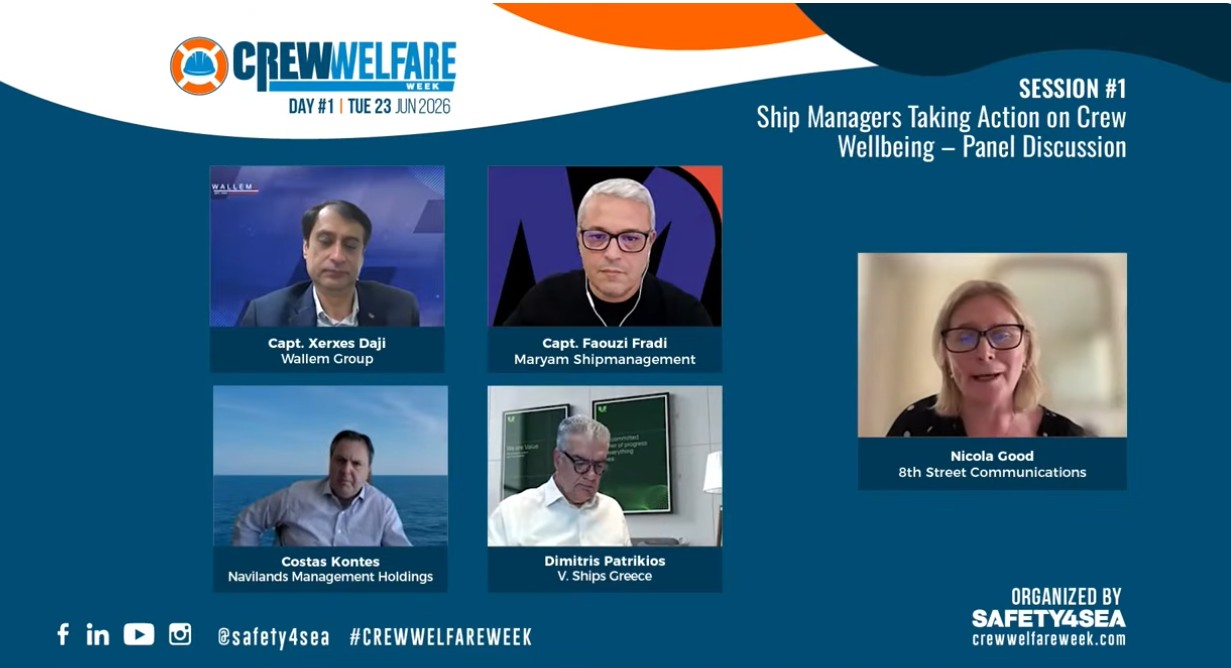
During the 2026 Crew Welfare Week, an illuminating panel discussion moderated by Nicola Good, Maritime Communications Consultant at 8th Street Communications Ltd, brought together leading ship management experts to examine the challenges affecting crew welfare and the priorities for supporting healthier, safer and more sustainable careers at sea.
The discussion highlighted a persistent “two-tier” market, in which welfare standards can vary significantly across shipping sectors, reinforcing calls for a more consistent approach. From mental health and fatigue to connectivity, shore leave, administrative burdens and geopolitical risk, speakers agreed that crew welfare must move beyond compliance and become an integral part of organisational culture and operational decision-making.
The panel featured Capt. Xerxes Daji, Regional Director, India, Wallem Group; Capt. Faouzi Fradi, Chief Executive Officer, Maryam Shipmanagement; Costas Kontes, Chief Commercial Officer, Navilands Management Holdings S.A.; and Dimitris Patrikios, Managing Director, V. Ships Greece Ltd.
7 takeaways from the panel
#1 Shipping still has a two-tier welfare market: Standards vary considerably across vessel sectors, highlighting the need for a more consistent approach across tankers, dry bulk, container shipping and other segments.
#2 Mental health stigma remains a barrier: Despite greater awareness, cultural factors and fear of speaking openly still prevent some seafarers from seeking support. Confidentiality, privacy and access to professional help are essential.
#3 Technology should reduce, not add to, workload: AI, digital tools and better connectivity should be used to simplify tasks, reduce administrative burdens and improve life onboard.
#4 Administrative and compliance fatigue require urgent attention: Increasing regulatory, inspection and reporting requirements risk adding to seafarer stress and reducing the time available for core operational duties and rest.
#5 Seafarers need stronger protection during geopolitical crises: The industry, governments and international organisations must strengthen advocacy for seafarers caught in conflict zones and ensure that recognition of seafarers as key workers translates into practical action.
#6 Global mobility remains unnecessarily complex: A universally recognised seafarer travel document and a more unified certification system could facilitate crew changes and reduce bureaucratic hurdles.
#7 Crew welfare requires wider stakeholder involvement: Shipowners and managers cannot act alone; terminals, ports, charterers, governments and other stakeholders must also be part of the discussion.
Seafarers at the heart of ship management
Opening the discussion, the speakers presented their respective approaches to crew welfare, with a common message emerging: seafarers are not simply part of shipping operations, but the people on whom the industry’s safety, performance and long-term sustainability depend.
Capt. Daji explained that Wallem’s approach is built around three pillars: engagement, empowerment and wellness.
“We consider the seafarer as the heart of our organization because without the seafarer, a ship manning company or a ship management company would be completely lost,” he said. “We think we are only as good as the seafarers we put onboard our vessels.”
Regular interaction with seafarers and their families, investment in training and safety campaigns, and the empowerment of those onboard to make operational decisions all form part of this framework.
They are the people at sea. They need to be the decision takers. We need to back them from ashore,
…Capt. Daji added.
Capt. Fradi emphasised the importance of listening to seafarers and adapting welfare measures to their different cultural backgrounds, nationalities, ages and personal circumstances.
“We believe that the welfare of seafarers varies a lot considering their background, their cultural background, their nationalities and also their age and different generations,” he said.
Alongside internet connectivity, mental health services, telemedicine and remote training, he stressed the need to customise welfare support according to the specific needs of crews.
Costas Kontes highlighted the importance of getting the fundamentals right, including transparent recruitment, fair and competitive wages, reliable rotations and support for seafarers’ families.
Our assets are the crew and the people that are managing our vessels,
…he said.
For Navilands, welfare standards should remain consistent irrespective of the client involved.
“If the client is not willing to accept those packages that are important for our seafarers, then it’s not the client we want to have,” Kontes noted.
Dimitris Patrikios similarly described seafarers as the actual performers of the shipping venture.
“The most important asset in shipping is not only the hard assets but the seafarers, because the seafarers are the actual players, the actual actors, the actual performers of the shipping venture,” he said.
With V. Ships drawing on a pool of around 45,000 seafarers, he highlighted initiatives supporting welfare, career progression, soft-skills training, cadets, women at sea and opportunities for seafarers who later wish to transition to shore-based careers.
A two-tier market remains
Despite considerable progress, the panel identified uneven welfare standards across the maritime industry.
According to Patrikios, shipping still operates as a “two-tier market”, with different levels of attention to crew welfare between tankers, dry cargo ships and other vessel segments.
“The approach of shipowners regarding crew welfare is a two-tier market. It is different in the tankers, different in dry cargo and different in other types of vessels,” he said.
He observed that significant progress has been made in the tanker sector, partly because of the influence and pressure exerted by charterers and oil majors. Mental health, for example, was rarely discussed a decade ago but has since become a major industry concern.
“I remember in 2015 nobody was talking about mental health. Now it is one of the major issues and it is widely discussed,” Patrikios said.
Nevertheless, the panel called for a more uniform approach across shipping sectors.
“Operational excellence and crew welfare are not competing priorities. They are mutually dependent,” Patrikios stressed. “My motto is: a happy ship is a safe ship.”
The point was echoed throughout the discussion. Healthy, well-rested and motivated seafarers are more likely to contribute to safe vessel operations, stronger performance and better decision-making. Welfare, therefore, should not be considered an additional cost or a competing priority, but an essential condition for sustainable operational excellence.
Mental health, fatigue and shore leave remain urgent concerns
When asked about the industry’s most urgent crew welfare challenges, Capt. Daji pointed to the continuing stigma surrounding mental health.
“If a seafarer has a physical issue, he goes to the master and immediately reports it. But the seafarer is still very reluctant to discuss mental health,” he said.
Isolation, long contracts and prolonged periods away from family can increase vulnerability to stress, anxiety and depression.
Capt. Daji also questioned assumptions that connectivity is now universally available.
There are still seafarers who don’t have access to internet. There are owners or managers who still charge their crew for internet or give very minimal bandwidth,
…he said.
Fatigue and work-rest hour violations remain further concerns, particularly on vessels engaged in demanding trades or frequent port calls.
“Work and rest hours are still high on violations in most companies. We need more work-life balance,” Capt. Daji said.
Shore leave was another recurring issue. Although leaving the vessel can offer important benefits for physical and psychological wellbeing, seafarers continue to face restrictions at ports and private terminals.
“We need to understand that a seafarer needs to go ashore regularly. That will also help with mental and physical wellbeing,” he added.
The panel’s message was clear: basic welfare needs cannot be addressed by shipping companies alone. Port authorities, terminals, governments and other stakeholders also have responsibilities.
Seafarers cannot be key workers only during crises
The discussion also examined the impact of geopolitical uncertainty, particularly when seafarers find themselves exposed to conflict and security threats.
Patrikios stressed that companies must remain close to their people, listen to their concerns and create a psychologically safe environment in which seafarers can discuss problems openly.
We must be next to them and listen to them, create the psychological safety context within which they can discuss openly the problems and try to find solutions,
…he said.
He added that seafarers want to feel that they are part of a family and that they are being taken care of, especially during periods of crisis.
At the same time, the wider industry must speak with a common voice to protect crews and ensure that seafarers are not caught in, or “weaponised” by, geopolitical conflicts.
Capt. Fradi warned against a familiar pattern. During major crises, including COVID-19 and periods of heightened piracy, the industry repeatedly declares that seafarers are key workers. Yet once the immediate crisis passes, the commitment often fades.
“Each time we bring this voice that seafarers are key workers and seafarers need to have priority, and then as soon as the crisis is over, that also goes over with it,” he said.
His final message on the issue was even more direct: “We brought it up during COVID. We have to go back to our word and make it happen. Seafarers are key workers.”
This recognition, the panel argued, must become permanent and translate into practical outcomes, including easier crew changes, more efficient visa procedures, better shore-leave access and greater international cooperation.
Empowerment can help balance performance and wellbeing
The question of how to reconcile operational demands with crew wellbeing was central to the discussion. Capt. Fradi argued that masters must be genuinely empowered to make decisions in the interests of their crews.
“The captain should be empowered. The master of the ship should be able to make a decision and say, ‘My crew has been working very hard. Now I need to drop anchor for people to take a few hours of rest,’” he said.
Where a vessel is operating under particularly demanding conditions, additional crew may also be necessary.
Capt. Daji similarly linked empowerment directly with performance.
“Empowering the seafarer would help because if they know that they are in charge and they will get support from the office, then they will be able to work better,” he said.
The panel also highlighted the role of technology in reducing workload. Digital solutions and artificial intelligence have the potential to simplify inspection preparation, reduce administrative burdens and help crews focus on higher-value tasks.
Capt. Fradi encouraged the industry not to fear AI, but to use it as an enabler.
“AI is here to stay and we need to integrate it and make it available for our seafarers so they can use it,” he said. “We should not be scared of AI. We should bring it in, we should use it, we should give it to our seafarers and make their life easier.”
However, technology must be introduced responsibly and accompanied by training.
Patrikios warned that seafarers are already being asked to operate increasingly sophisticated vessels while complying with an expanding regulatory framework and evolving inspection regimes.
“The challenge is not only technology. The challenge is how to ensure that our seafarers receive sufficient training, the support and the time to adapt,” he said.
“We must not create compliance fatigue.”
Crew welfare must move beyond compliance
One of the strongest themes to emerge was that welfare cannot remain a box-ticking exercise.
Asked to identify an uncomfortable truth the industry still avoids addressing, Capt. Daji said crew welfare is sometimes treated as a compliance requirement rather than as a strategic responsibility.
“Still sometimes crew welfare is treated as a compliance thing because of MLC. We need to make it a strategic partnership,” he said.
“We need in shipping to become more human-centric.”
He also stressed the importance of building an environment in which seafarers can raise concerns without fearing retaliation or losing future contracts.
“We need to foster an environment where they can speak out without us taking it in a negative way ashore and retaliating,” Capt. Daji said.
Patrikios agreed that welfare must form part of company culture.
“The most important thing that gives the energy for moving forward is the culture of the company. Crew welfare should be part of this culture and we should move beyond compliance. It is not only to tick boxes,” he said.
He also highlighted the importance of measuring wellbeing and adapting to the needs of younger generations.
We must adapt our culture to today’s requirements. We must not analyse and explain things from what we experienced two decades or three decades ago,
…Patrikios said.
Kontes similarly argued that welfare initiatives will add limited value unless companies listen directly to seafarers and act on their feedback.
“The important thing about crew welfare really is to listen, make regular surveys in order to be able to get the feedback from seafarers,” he said. “Only when you learn what is happening will you be able to address the solution.”
Capt. Fradi, meanwhile, identified the slow pace of regulatory change as another uncomfortable truth.
“The uncomfortable truth is the incredibly slow pace at which regulations are being amended,” he said, arguing that stronger and clearer international requirements could help raise minimum standards across the industry rather than leaving progress dependent largely on voluntary initiatives and good intentions.
The discussion ultimately underlined that meaningful crew welfare cannot be delivered through isolated initiatives alone. It requires supportive company cultures, empowered masters, listening to seafarers, appropriate staffing, better training, reduced administrative burdens and cooperation across the wider maritime ecosystem.
As the panel made clear, the relationship between safety, performance and wellbeing should no longer be seen as a trade-off.
A happy ship is a safe ship and operational excellence ultimately begins with the people onboard.
Explore more by watching the video below
Content Original Link:
" target="_blank">