

Crew Welfare Week 2026: Crew welfare must be treated as a strategic investment
Shipping must move beyond minimum compliance and recognise crew welfare as a strategic investment in safety, resilience and the industry’s future workforce, experts stressed during a panel discussion at the 2026 Crew Welfare Week.
The panel examined how fatigue, geopolitical instability, digitalisation and the energy transition are reshaping life at sea. Speakers agreed that seafarers must be directly involved in decisions affecting their work, while stronger employment conditions, meaningful career prospects and a more honest but positive industry narrative will be essential to attract and retain the next generation.
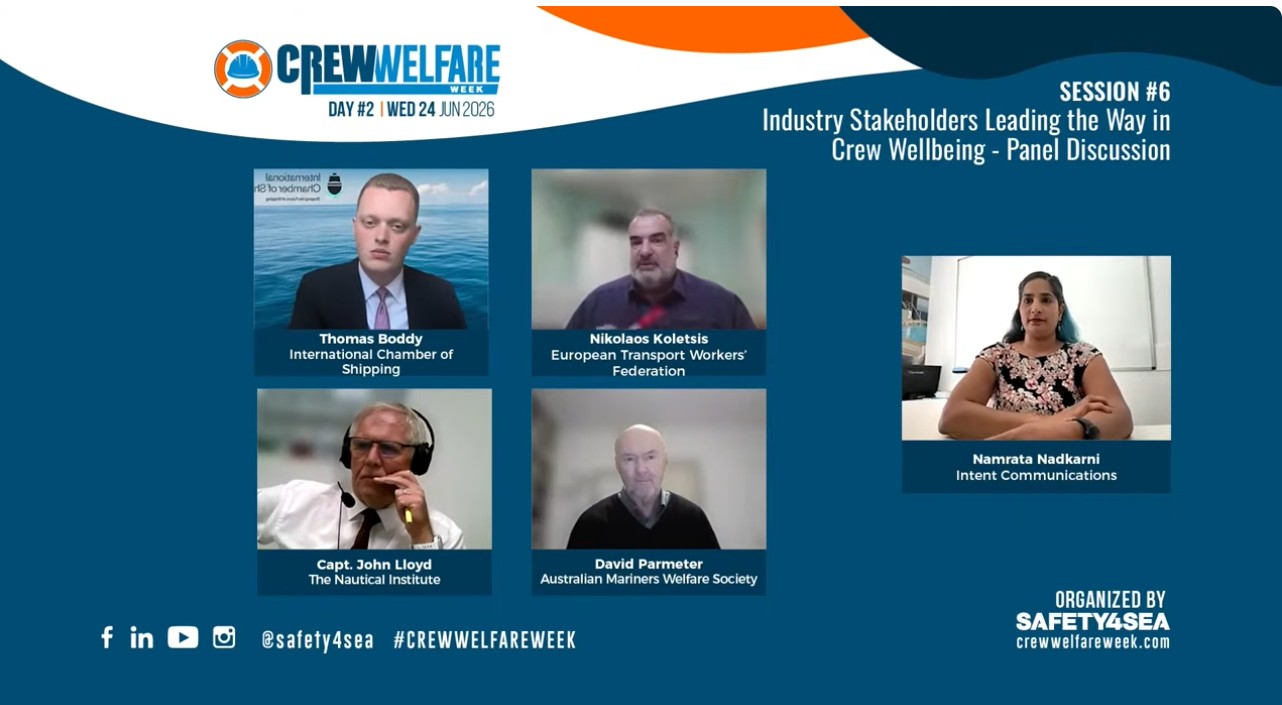
Moderated by Namrata Nadkarni, CEO and Founder of Intent Communications, the discussion featured Thomas Boddy, Policy Officer, Employment Affairs, International Chamber of Shipping; Nikolaos Koletsis, Senior Policy Officer for Maritime Transport, European Transport Workers’ Federation; Capt. John Lloyd, FNI, Chief Operating Officer, The Nautical Institute; and David Parmeter, Chair, Australian Mariners Welfare Society.
10 industry actions identified by the panel
#1 Set standards above minimum compliance: Treat MLC and STCW requirements as a baseline and develop higher, more humane expectations for seafarer employment and welfare.
#2 Reform work and rest hour arrangements: Use the ILO–IMO review process to address excessive working hours, inaccurate recording and the underlying causes of fatigue.
#3 Reduce administrative burdens: Review reporting requirements and procedures that take seafarers away from operational duties and rest.
#4 Give seafarers a voice in the transition: Establish structured consultation and feedback processes for new fuels, technologies and operational changes.
#5 Expand practical alternative-fuel training: Continue developing and rolling out “train the trainer” programmes while ensuring training is timely, realistic and accessible globally.
#6 Improve abandonment data: Make international databases easier to filter so that authorities and organisations can identify cases requiring specific action.
#7 Strengthen employment continuity: Move where possible beyond voyage-by-voyage relationships and offer greater career security, development and connection with employers.
#8 Improve recruitment through better conditions: Provide meaningful career prospects, reliable connectivity, appropriate equipment and inclusive workplaces to attract broader talent.
#9 Recognise welfare as an investment: Connect crew wellbeing with safety, retention, reputation and commercial resilience rather than treating it as a cost.
#10 Advocate beyond the maritime sector: Engage governments and political decision-makers and continue pushing for mandatory recognition of seafarers as key workers.
Moving beyond minimum standards
A central message from the panel was that compliance with the Maritime Labour Convention and STCW requirements should be viewed as the industry’s baseline, not its ultimate welfare ambition.
Parmeter argued that shipping needs to establish accepted standards above the minimum and assess ship operators and crewing agencies against those expectations.
We need to move beyond bare minimum compliance in the industry. There is more we can do rather than just relying on minimum standards. The industry should say: let’s go for a higher standard.
..he said.
Koletsis reinforced this point, describing international requirements as “the floor, not the ceiling”. The global nature of shipping requires consistent international standards, he explained, but stronger implementation and a clear long-term vision are also necessary.
Capt. Lloyd noted that the MLC has been an important step forward, but questioned whether implementation, monitoring and enforcement are sufficiently robust. Welfare deficiencies can be harder to identify than defective equipment, making inspector training and consistent enforcement particularly important.
Fatigue requires urgent regulatory attention
Fatigue, excessive workloads and extended tours of duty emerged as some of the most pressing concerns.
Parmeter said seafarers are increasingly expected to do more with fewer people and less time in port. Long periods onboard compound fatigue, isolation and the psychological strain of being separated from family.
If someone is going to be on a vessel for nine months, that’s a long time away from home and a long time away from family. That compounds fatigue, the sense of isolation and the mental health challenges that go with that.
…he said.
Koletsis stressed that fatigue is both a welfare and a safety issue because it directly affects decision-making and increases accident risk. He pointed to excessive working hours, disrupted sleeping patterns and administrative burdens as factors that must be addressed together.
A forthcoming discussion within the joint ILO–IMO tripartite working group presents an opportunity to reform work and rest hour arrangements, he said. Reducing reporting obligations and unnecessary bureaucracy could also ease the pressure placed on smaller onboard teams.
Technology could support this work. Capt. Lloyd suggested that vessel trading patterns, pilotage, mooring and cargo operations could be analysed to produce a more realistic picture of onboard workloads.
We put a lot of effort into seeing how we can be more efficient, but I don’t think we are paying enough attention to the human-factor side; I think we could, and I think we should.
…he said.
Geopolitical uncertainty is affecting seafarer wellbeing
The discussion also highlighted the psychological and operational consequences of geopolitical instability.
Boddy noted that seafarers caught in areas of conflict face danger, uncertainty and the potential disruption of crew changes and repatriation. Such crises can also increase the risk of abandonment.
ICS is coordinating an abandonment task force and seeking to improve the way information can be extracted from the joint ILO–IMO database. More focused and customisable data could help governments, flag States and other responsible stakeholders identify the cases requiring their intervention.
Capt. Lloyd added that geopolitical instability is only one source of uncertainty. Seafarers also face piracy, criminalisation and potential legal responsibility for cargo-related activities over which they may have limited control.
Parmeter raised a further concern regarding seafarers working aboard shadow or dark-fleet vessels. Questions remain over their employment status, insurance, certification and whether they fully understand the circumstances and risks surrounding the ships on which they serve.
Seafarers need a voice in the energy transition
The energy transition and digitalisation are introducing new technologies, fuels and working practices, but the panel warned that uncertainty itself can become a significant source of stress.
Parmeter called for structured feedback loops that give active seafarers a direct voice in how the transition is managed.
Get input from actual, on-the-job seafarers. Get their thoughts on how to manage this and then close the loop with feedback,
…he said.
Seafarers would experience less stress if they knew they could influence the transition and receive clear information about how it would affect their roles and careers, he added.
Boddy agreed that the connection between seafarers and international transition initiatives could be strengthened. He highlighted training frameworks developed for ammonia, methanol and hydrogen, while stressing that publishing guidance is not enough.
“How can we make sure that the frameworks get into the right hands and actually influence training?” he asked.
ICS has begun using a “train the trainer” model, with an initial programme held in Hong Kong, and intends to expand the approach to other regions.
Capt. Lloyd warned that training must be timely, practical and based on a clearer understanding of which fuels and technologies will be adopted. Emergency response for alternative fuels cannot be taught effectively only through computer-based courses, he argued.
The industry needs to prepare the necessary training infrastructure now, while activating specific programmes when technologies and vessel requirements become clearer.
Better jobs will strengthen recruitment and retention
Working conditions and crew welfare will play a decisive role in whether shipping can recruit and retain enough skilled seafarers.
Koletsis said the industry already has considerable agreement about its problems and potential solutions, but progress remains too slow.
“If we fix the conditions, then we will fix the attractiveness,” he said. “We cannot offer top skills without offering good jobs and strong career prospects.”
The panel also called for shipping to broaden its recruitment pool and create conditions in which women and other underrepresented groups can build sustainable careers.
Boddy said addressing violence, harassment and discrimination would make maritime careers more accessible to a wider range of people. Recent MLC-related work has introduced stronger provisions addressing violence and harassment onboard, although further regulatory and practical progress is needed.
Parmeter urged operators to see workforce diversity as an opportunity rather than a burden. He also described connectivity as a fundamental right rather than an optional benefit.
“You won’t have seafarers staying on ships unless they have that connectivity,” he warned.
Capt. Lloyd identified three elements needed to attract future talent: image, opportunity and honesty.
Shipping must present its importance, technological development and career possibilities more positively, rather than allowing the public narrative to be dominated by accidents and crises.
At the same time, companies must be honest that seafaring is not a conventional nine-to-five job and requires commitment, separation from family and high professional standards.
Continuity of employment can build stronger cultures
Capt. Lloyd also questioned the long-term impact of voyage-by-voyage contracts, arguing that greater continuity of employment could strengthen security, loyalty and company culture.
Long-term relationships allow employers to understand seafarers as individuals, identify their development needs and invest appropriately in their careers. Better-trained and more experienced personnel can then contribute to safer and more efficient operations.
“We are a people organisation and a people community,” he said. “Technology will help us be better, but people will continue to make the decisions.”
Parmeter linked investment in people with commercial credibility, recalling a charterer who assessed safety performance on the basis that a company looking after its people was likely to be managing other risks effectively.
Investing in crew welfare is therefore not separate from commercial performance. It can strengthen safety culture, retention, reputation and confidence across the maritime value chain.
Welfare cannot be treated as a cost
When asked to identify an uncomfortable truth, Koletsis pointed to the gap between the industry’s public praise of seafarers and its willingness to make difficult decisions that could improve their lives.
“The pace of change is slow. Sometimes we are treating welfare as a cost and not as a strategic investment,” he said.
The industry repeatedly celebrates seafarers’ resilience, but can hesitate when asked to reduce working hours, strengthen their legal status or introduce meaningful protections, he observed.
Capt. Lloyd identified another commercial reality: high-quality welfare, employment and training cannot always be delivered through the cheapest possible solution.
“If our constant drive is to find the cheapest possible solution, we are unlikely to find the best possible solution,” he said. “You can’t do it on the cheap.”
Reaching decision-makers outside shipping
The panel concluded that maritime stakeholders must avoid discussing welfare only among themselves.
Boddy said the effort to designate seafarers formally as key workers had not yet achieved a mandatory international requirement. Governments had accepted only a non-mandatory provision, despite the protections that formal recognition could provide during international emergencies.
ICS and its social partners should continue advocating for mandatory recognition, he said.
He also warned that seafarers are vulnerable to decisions made outside the maritime industry. Shipping organisations must therefore seek to influence political leaders and government decision-makers rather than remain inside a “sector-specific echo chamber”.
Capt. Lloyd closed with a message for employers and seafarers:
“Your success is dependent upon your people. If you look after them, they are much more likely to look after you,” he said. “To individual seafarers: you are the key workers, whether designated or not.
Content Original Link:
" target="_blank">