
Crew Welfare Week 2026: Collaboration, not competition, can advance women in maritime
The maritime industry must move beyond visibility campaigns and tick-box initiatives by embedding gender inclusion into vessel operations, workplace culture and career development, experts stressed during a panel discussion at the 2026 Crew Welfare Week.
Speakers called for repeated gender-sensitisation and bystander training across the entire workforce, reliable reporting mechanisms and practical changes to equipment, facilities and employment policies. They also highlighted the need to involve men in the process, improve maternity and return-to-work arrangements and give women greater access to decision-making positions.
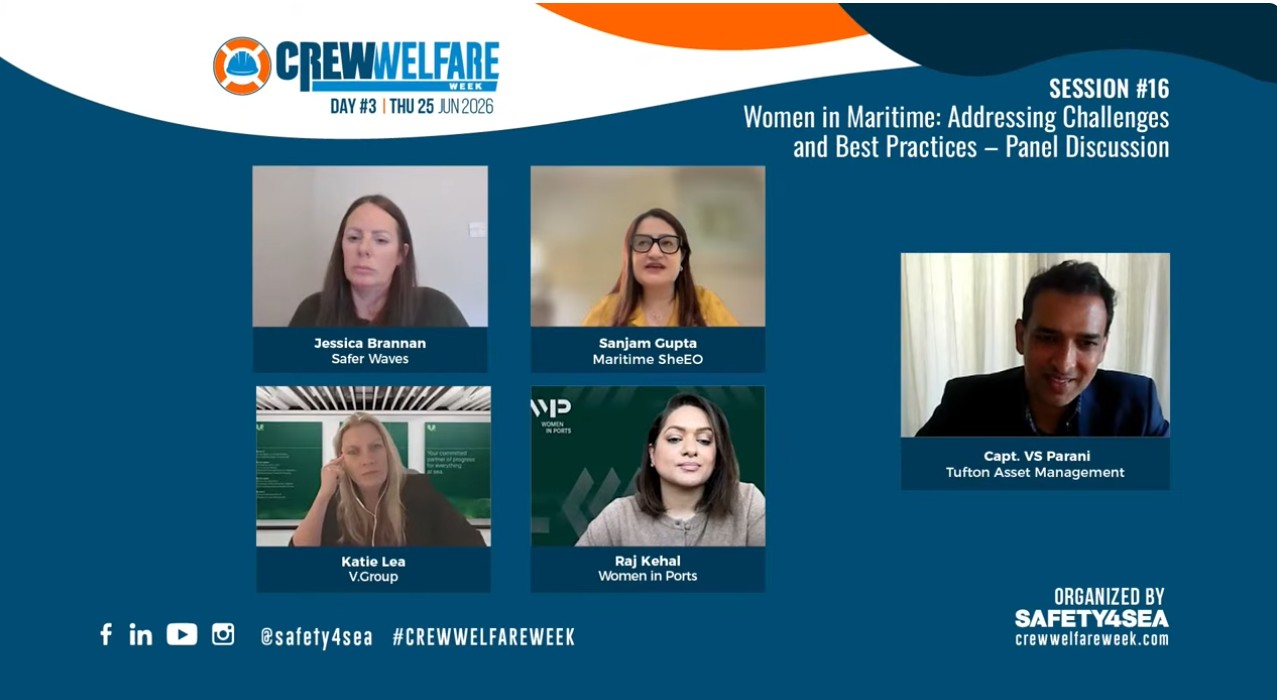
Moderated by Capt. VS Parani, Vice President – Marine, Tufton Asset Management, the discussion featured Sanjam Gupta, Founder, Maritime SheEO; Katie Lea, Global Director, Marine Learning & Development, V.Group; Jessica Brannan, CEO, Safer Waves; and Raj Kehal, CEO, Women in Ports.
10 industry actions identified by the panel to advance women in maritime
#1 Prepare vessels before introducing mixed-gender crews: Assess facilities, equipment, policies and onboard culture rather than focusing only on recruitment numbers.
#2 Provide inclusive facilities: Ensure suitable PPE, changing and laundry arrangements, sanitary bins and other basic requirements.
#3 Make gender-sensitisation training continuous: Repeat training throughout careers and include existing senior officers, shore teams and all genders.
#4 Expand bystander and responder training: Teach crews how to challenge inappropriate conduct and train managers to handle disclosures appropriately.
#5 Create multiple safe reporting channels: Provide confidential options that account for hierarchy, isolation and the immediate safety of the person reporting.
#6 Protect those who raise concerns: Investigate reports thoroughly and ensure that consequences apply to perpetrators rather than complainants.
#7 Adopt fair pregnancy policies: Offer medically supervised duties, appropriate pay protection and defined return-to-work arrangements.
#8 Develop flexible career pathways: Enable movement between sea and shore without ending progression or preventing a later return to sea.
#9 Set and publish diversity targets: Measure recruitment, retention, promotion and complaint outcomes across all organisational levels.
#10 Fund access to leadership: Sponsor women’s development and ensure they participate in boardroom and policy decisions.
Representation remains uneven
Opening the discussion, Capt. Parani highlighted the uneven representation of women across the maritime sector. While women account for a larger proportion of shore-based, administrative, cruise and yachting roles, their representation among seafarers remains particularly low.
Lea said women currently account for approximately 7% of V.Group’s seafaring workforce, but most work within the leisure sector. Representation aboard cargo and offshore vessels remains closer to the wider industry figure of approximately 1%.
This means that companies must consider not only how to recruit women, but also how to create conditions in which they feel safe and can develop sustainable careers.
We want to make careers at sea attractive for women, especially for the younger generations coming through. We also want to make it a safe environment and ensure they have access to the right support networks and reporting channels.
…Lea said.
Gupta highlighted a similar gap in leadership. Women may be well represented in support and entry-level roles, but their numbers often decline significantly after middle management.
Once you cross the mid-management level, it is very difficult for a lot of women to rise and break the glass ceiling
…she said.
Inclusion must be intentional
Simply placing women onboard without preparing the vessel and crew is unlikely to produce sustainable progress.
“The first thing I would say is that you need to be quite intentional about introducing female seafarers onboard vessels,” Lea explained.
“Training everybody is the biggest component,” Lea said. “Everybody must be clear about the policies and expectations, and everybody must be held accountable.”
Mixed-gender crewing should therefore be approached as a structured change-management process, supported by careful communication and engagement.
Lea also stressed that male seafarers must not be excluded from the process. Integrating women into traditionally male working environments represents a change for the whole crew, and concerns or misconceptions should be addressed openly rather than dismissed.
Gupta shared an example in which a company’s first attempt to employ women onboard failed because the existing crew had received no preparation.
They did nothing to prepare the crew for women coming onboard for the first time. Initiatives such as gender-sensitisation programmes are therefore very important.
… she said.
Safety is essential for retention
Recruitment efforts will have limited value unless women feel safe, respected and supported throughout their careers.
Brannan said Safer Waves supports seafarers of all genders, but the majority of those contacting the organisation are women who have experienced sexual harassment, assault or gender discrimination while working at sea.
Unless women feel safe, respected and supported throughout their careers, it is going to affect not only recruitment but also retention
..she warned.
Research conducted by Safer Waves among self-selected respondents found that 80% had witnessed or experienced some form of sexual violence at sea. Only 30% had spoken to anyone about it, while just 35% of those who reported formally were satisfied with the response and action taken.
Fear of not being believed, losing a position, being transferred, damaging future references or suffering reputational harm can discourage reporting.
“We need to build trust in the reporting systems,” Brannan said. “Reports must be taken seriously, investigations must be thorough and there must be consequences for the people behaving in this manner—not for the people reporting it.”
A poor response to an initial disclosure can discourage someone from ever raising the matter again. Managers and senior officers must therefore be trained to listen, avoid judgement and provide appropriate support.
Reporting must also be safe
Kehal stressed that the existence of a reporting system does not necessarily mean that it can be used safely.
“It is not only about reporting it; it is about safely reporting it,” she said.
A seafarer may still be living and working in close proximity to the person involved in an incident. An immediate report could therefore increase isolation or vulnerability unless protective arrangements are available.
Multiple confidential reporting channels are essential, particularly because hierarchy and physical isolation can make it difficult to approach a direct superior.
Lea said companies must also clearly define acceptable behaviour across multicultural crews. Personal boundaries, humour and physical contact may be interpreted differently across nationalities, but cultural differences should not be used to excuse harmful conduct.
Training should help people understand expected behaviour, recognise when boundaries have been crossed and know how to respond when concerns are raised.
Training must include everyone
The panel strongly rejected the idea that women alone should be trained to manage difficult or unsafe situations.
“The emphasis is often placed on preparing women: what if this happens, and what if that happens?” Gupta said. “But the onus has to be on training the entire workforce.”
Gender-sensitisation programmes should include senior officers, shore managers and existing personnel, not only new cadets. Those already holding positions of authority are often the people who shape onboard culture and determine how complaints are handled.
Lea said training must be continuous rather than delivered once.
“It has to be consistent messaging from the top all the way down,” she explained. “Superintendents must be saying the same thing as captains, and the message should be reinforced during safety meetings onboard.”
Brannan highlighted the importance of bystander training. Crew members should understand not only their right to be safe but also their responsibility to challenge inappropriate conduct.
She gave the example of a sexist comment made in a room where some people laugh, some remain silent and others walk away. Even those who do not agree with the comment may appear to support it when they fail to intervene.
A calm response such as “that was inappropriate” can prevent harmful behaviour from being normalised and help the affected person feel less isolated.
Pregnancy should not become a career-ending risk
Pregnancy, maternity and caring responsibilities continue to influence women’s long-term participation in maritime careers.
Lea said flexible career pathways can help seafarers move between sea and shore without permanently limiting their progression. Ship-to-shore and shore-to-ship programmes give people the opportunity to try different roles, respond to changing family circumstances and later return to sea.
Gupta highlighted concerns raised by female maritime pilots. Some reported hiding pregnancies because they feared being grounded, moved to lower-paid desk duties, losing licence progression or facing intrusive questions about family planning.
“The absence of policies forces women to work unsafely, hide pregnancies, accept pay cuts or even leave the profession permanently,” she said.
She called for medically supervised working arrangements, maintained pay during light duties and structured return-to-work programmes.
Open discussions can help companies plan, but women must be confident that disclosing pregnancy or family plans will not lead to discrimination.
“These conversations should happen openly, but women need to have faith that they will be treated fairly,” Gupta said.
Small structural changes can have a major impact
The panel also identified basic facilities and equipment as important indicators of whether a workplace was genuinely designed to include women.
Kehal recalled vessels at a port that had operated for decades without sanitary bins. Female interns and apprentices were forced to carry used sanitary products in their pockets until the problem was raised by a woman involved in decision-making.
The quick solution was to put sanitary bins onboard and treat it as business as usual
..she said.
Menstrual health and menopause should be discussed without stigma, while appropriate facilities should be viewed as a basic workplace requirement.
Kehal also challenged the assumption that women cannot perform physically demanding maritime roles.
“That perception is very outdated,” she said. “Technology and innovation have changed many of these jobs.”
Some work remains physically demanding, but recruitment should be based on the actual requirements of the role rather than stereotypes about gender.
Visibility must lead to influence
Women are increasingly visible at maritime events and in senior positions, but visibility does not automatically result in structural change.
We are great at celebrating women, but we do not always translate their concerns into meaningful change
…Kehal said.
Women need access to boardrooms, leadership positions and the spaces in which policies, budgets and operational decisions are determined.
“Until we fund women and give them access to those spaces, we are not going to have change,” she said. “Put your money where your mouth is.”
Female role models are also important for younger entrants. Brannan noted that a cadet who has never seen a female chief officer or master may struggle to imagine her own long-term progression.
Lea added that social media and digital communities are already helping women see maritime careers more clearly. Female cadets frequently report being inspired by engineers and seafarers sharing their working lives online.
Digital platforms can also support mentoring, peer networks, regular surveys and easier access to reporting and welfare services.
Targets can strengthen accountability
Gupta called for companies to establish and disclose measurable diversity targets covering recruitment, retention and promotion.
“Unless you set out a goal, you are never going to reach it,” she said.
Organisations should report representation at entry, middle-management and senior levels, while comparing promotion rates between women and men. Complaint handling should also be assessed, including whether those who report misconduct remain employed and return to sea.
Companies that meet their targets can provide examples of effective practice, while those that do not should explain the reasons and identify corrective action.
Concluding the discussion, Capt. Parani said the industry must work through “collaboration, not competition” and involve both women and men in creating safer, more equitable workplaces.
Structural adjustments, repeated training, reliable reporting and accountable leadership will ultimately determine whether increased recruitment translates into long-term careers.
Explore more by watching the video herebelow:
Content Original Link:
" target="_blank">