



Crew Welfare Week 2026: Tackling fatigue is key to a healthier life at sea
Physical wellness at sea cannot be addressed through isolated health campaigns or individual lifestyle choices alone. It requires adequate rest, nutritious food, opportunities to exercise, appropriate living conditions and coordinated action across the maritime value chain, experts stressed during a panel discussion at the 2026 Crew Welfare Week.
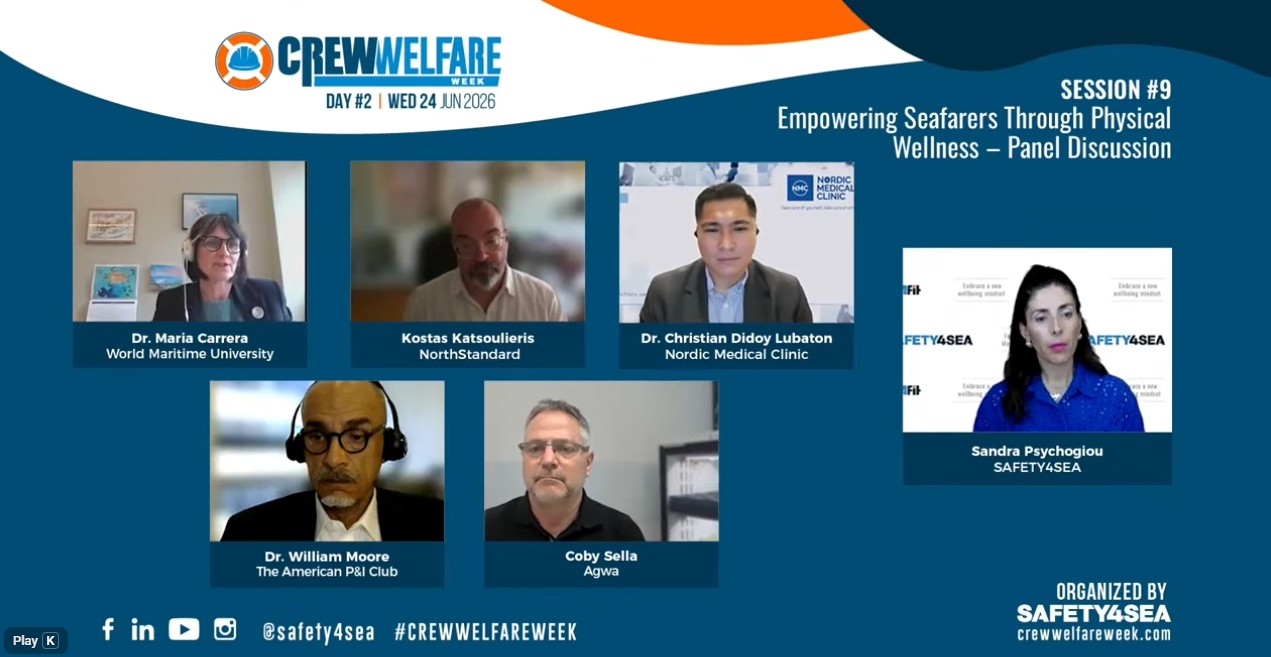
Moderated by Sandra Psychogiou, Editor in Chief, SAFETY4SEA, the session explored the practical measures needed to support healthier lifestyles onboard. The discussion identified fatigue as the most urgent and systemic challenge, while also highlighting chronic health conditions, inadequate food budgets, restricted shore leave and poor-quality onboard facilities.
Speakers included Dr. Maria Carrera, Lecturer, World Maritime University; Kostas Katsoulieris, P&I Claims Director – Greece, NorthStandard; Dr. Christian Didoy Lubaton, Managing Director, Nordic Medical Clinic; Dr. William Moore, Global Loss Prevention Director – S.V.P., The American P&I Club; and Coby Sella, CEO, Agwa.
10 industry actions identified by the panel to strengthen physical wellness at sea
#1 Address fatigue as a systemic risk: Review workloads, staffing, schedules and working hours rather than relying solely on individual fatigue-management advice.
#2 Protect restorative sleep: Improve work-rest arrangements and reduce interruptions that prevent seafarers from receiving sufficient, high-quality sleep.
#3 Apply an integrated health approach: Consider physical, mental and social wellbeing together when developing crew welfare programmes.
#4 Manage existing conditions onboard: Use health education, monitoring, telemedicine and appropriate medication plans to support seafarers with chronic conditions.
#5 Increase food budgets where necessary: Ensure allocations are sufficient to provide fresh, nutritious and culturally appropriate meals.
#6 Use technology to improve nutrition: Explore onboard growing systems and data-led tools that can extend access to fresh food and measure long-term health outcomes.
#7 Maintain appropriate exercise facilities: Provide safe, functional gym equipment and realistic alternatives for vessels with limited space.
#8 Give seafarers time to exercise and recover: Recognise that physical activity requires protected time, not only equipment or encouragement.
#9 Improve accommodation and communal spaces: Prioritise quality bedding, lighting, temperature control, reduced vibration and welcoming areas for social interaction.
#10 Build global support for shore leave: Engage port States, flag States, terminals and charterers to remove barriers and translate essential-worker recognition into practice.
Physical health cannot be considered in isolation
Opening the discussion, the panel agreed that physical wellness is closely connected with mental and social wellbeing.
Dr. Carrera said health should be approached as a whole rather than divided into separate areas.
“We cannot consider that someone is fully healthy if we don’t look at these three components as a whole,” she said, referring to physical, mental and social health. “The three elements should be understood, considered and integrated into any wellbeing practice.”
Katsoulieris similarly described physical wellness as the ability to remain healthy enough to cope with both professional and personal challenges.
For seafarers, however, the environment is fundamentally different from most shore-based workplaces. Their vessel is simultaneously their workplace, home, dining area and recreational space, often for many months.
To be well, we should sleep well, eat well and exercise well,
…Katsoulieris said.
Dr. Lubaton compared a seafarer’s physical condition with the seaworthiness of a vessel.
“We only have one body as our vessel,” he explained. “Is the person ready, and is the body ready, for life onboard?”
Health education is therefore central to helping seafarers care for themselves, continue performing their duties and support their colleagues and families.
Fatigue remains the most critical concern
Fatigue emerged as the strongest common concern across the panel.
Katsoulieris described it as a longstanding problem that shipping understands but has still not managed effectively. Crew shortages, demanding schedules and the unique pressures of living and working in the same environment all contribute to the problem.
“Their home is also their office or their factory,” he said. “They are onboard the ship, going around the world, subject to foul weather, geopolitics and everything else that life can throw at them.”
Dr. Carrera said evidence continues to point to tiredness, sleep deprivation and exhaustion as major threats to seafarers’ health. Despite technological advances intended to simplify tasks, fatigue appears to be increasing rather than declining.
She highlighted extended working hours, long contracts, interrupted sleep and limited opportunities to leave the ship as interconnected pressures.
The sleep of seafarers is generally not very restorative. It is either limited in quantity or frequently interrupted, and it does not follow a regular sleep-and-wake pattern.
… Dr. Carrera said.
According to the research discussed during the panel, seafarers may work between 72 and 91 hours per week over contracts lasting several months, often without regular days off.
When asked which single issue should receive priority, Katsoulieris again selected fatigue, noting its connection with cardiovascular health, mental wellbeing, illness and accident risk.
Dr. Moore agreed and suggested that increasing the number of people onboard could help distribute workloads more realistically.
Larger crews – three to five more onboard – would be very beneficial
…he said, acknowledging that such a change may be difficult but could have a substantial positive impact.
The industry must manage existing health conditions
The panel also argued that shipping must move beyond attempting to prevent every medical condition and become better at managing conditions that seafarers already have.
Dr. Lubaton identified non-communicable and lifestyle-related conditions—including type 2 diabetes, hypertension, musculoskeletal strain and kidney-related conditions—as recurring concerns.
We need to move to more than just prevention. We need to catch conditions while they are there onboard and catch them early.
…he said.
Poor nutrition, inadequate hydration, lack of rest and limited opportunities for physical activity can contribute to health problems developing or worsening over time.
Dr. Moore similarly said pre-employment medical examinations should not simply determine whether a seafarer is fit or unfit. They should help the individual understand their condition, medication and the lifestyle changes needed to manage their health at sea and at home.
“It is not always a question of whether somebody has a medical condition, but which condition they have and how it can best be managed,” he explained.
Better nutrition requires realistic budgets
Nutrition was identified as one of the clearest areas where management decisions can directly affect crew health and morale.
Dr. Lubaton said companies cannot claim to prioritise healthy eating while allocating budgets that make fresh and nutritious food unrealistic.
“At seven dollars per person per day, you don’t get to have fresh food,” he warned. “There needs to be leadership and management support if we really want to push for nutrition.”
Progress requires alignment between those supplying the food, those preparing it and those consuming it, he added.
Dr. Carrera stressed that food must not only meet minimum requirements for quantity and nutritional value but also respect the cultural and religious backgrounds of crew members.
We need to give seafarers not only the minimum standards to survive, but standards that guarantee their health and safety,
…she said.
Sella highlighted the potential of technology to increase access to fresh produce during long voyages. Moving food production from shore to the vessel can provide fresh greens while enabling operators to monitor what is produced and consumed.
You can get fresh food which is not obtainable after seven days at sea because it perishes, while also monitoring what seafarers are actually consuming,
…he said
He also noted that growing plants onboard can have an effect beyond nutrition. The presence of fresh greenery in shared spaces can create a calming environment and contribute to morale, particularly during stressful or uncertain voyages.
Katsoulieris agreed that food has an important social and emotional role.
“Every army marches on its stomach,” he said. “The importance of food to our wellbeing is well known.”
Exercise needs facilities, motivation and time
While many ships provide gyms or other recreational facilities, the panel warned that simply installing equipment is not enough.
Katsoulieris highlighted practical alternatives such as group stretching, exercises in cabins, bodyweight training and chair-based activities. Masters and senior officers can also encourage participation by leading group activities that support both fitness and team cohesion.
Dr. Lubaton said owners and managers must provide an environment in which exercise is genuinely possible.
He recalled speaking with a seafarer who wanted to use the onboard gym but found that the equipment was rusted and unsafe.
The role of owners and ship managers is to create a physical environment where seafarers can exercise and move around
…he said.
A supportive psychological environment is equally important. Companies can encourage activity through challenges, group programmes and recognition, while seafarers should see movement as part of their self-care and long-term health.
Dr. Carrera, however, stressed that time is as important as equipment. When rest periods are largely consumed by sleep, seafarers have little opportunity left for exercise, social interaction or recovery.
“Rest time involves more than sleeping,” she said. “Availability of time is fundamental to motivating seafarers to exercise and socialise with other crew members.”
Ships must provide an environment for recovery
Lighting, noise, heat, vibration, accommodation and bedding can all influence sleep quality and physical health.
Dr. Carrera said seafarers are continually exposed to both natural and industrial hazards. These pressures affect the body and mind, increase psychosocial risks and make restorative sleep more difficult.
Katsoulieris called for greater crew involvement during vessel design and construction. Seafarers can provide practical advice on accommodation, lighting, engine-room conditions, blackout arrangements and bedding because they will ultimately live and work in those spaces.
Dr. Lubaton highlighted how even basic equipment can be overlooked.
“I have seen a 15-year-old ship with a 15-year-old mattress,” he said. “The vessel has to provide a sense of home rather than a sense of prison.”
The panel also recognised the value of well-designed communal spaces. Sella suggested that shared meals and regular social activities can create an “island of calmness” that helps distinguish working time from periods of relaxation.
Shore leave is essential but remains difficult to deliver
Dr. Carrera described shore leave as both a fundamental right and an important health intervention. It allows seafarers to recover physically, socialise outside the vessel and regain motivation before returning onboard.
“It allows them to feel human again,” she said.
However, research discussed during the session indicates that many seafarers either receive no shore leave or go ashore only a small number of times during contracts lasting several months. Even when leave is possible, it may last only a few hours.
The panel acknowledged that shipowners and managers do not control every barrier. Port security requirements, terminal locations, geopolitical tensions, faster turnaround times and decisions by port States all affect access.
Dr. Moore said international rules can encourage shore leave, but implementation ultimately depends heavily on individual ports.
Katsoulieris argued that seafarers’ status as essential workers remains stronger on paper than in practice.
“We keep talking about key-worker and essential-worker status, but it does not yet exist in the practical world,” he said.
From awareness to practical action
Concluding the discussion, Dr. Lubaton summarised physical wellness through three simple actions: eat, move and sleep.
“We need to help seafarers eat better food, move more proactively and sleep well,” he said. “These are basic human needs.”
Achieving this requires both personal leadership and an enabling environment created by owners, managers, regulators, ports and other stakeholders.
Dr. Carrera connected healthy work with decent work, arguing that seafarers should not be expected to accept conditions considered unhealthy in other occupations.
Katsoulieris closed by thanking seafarers for sustaining global trade, while warning that awareness alone will not deliver meaningful change.
“We need to move from discussion into action,” he said. “This is a global industry, and there need to be global solutions.”
Explore more by watching the video herebelow:
Content Original Link:
" target="_blank">