



Crew Welfare Week 2026: Better data sharing can prove the value of preventive healthcare
Seafarer health must be treated as a core operational and risk-management priority, supported by preventive care, psychological safety and better use of industry data, experts stressed during a panel discussion at the 2026 Crew Welfare Week.
The discussion highlighted that shipping already collects significant health information, but much of it remains fragmented, commercially sensitive or difficult to compare. Greater collaboration and anonymised data sharing could help companies identify emerging risks, develop targeted interventions and demonstrate the commercial value of investing in prevention.
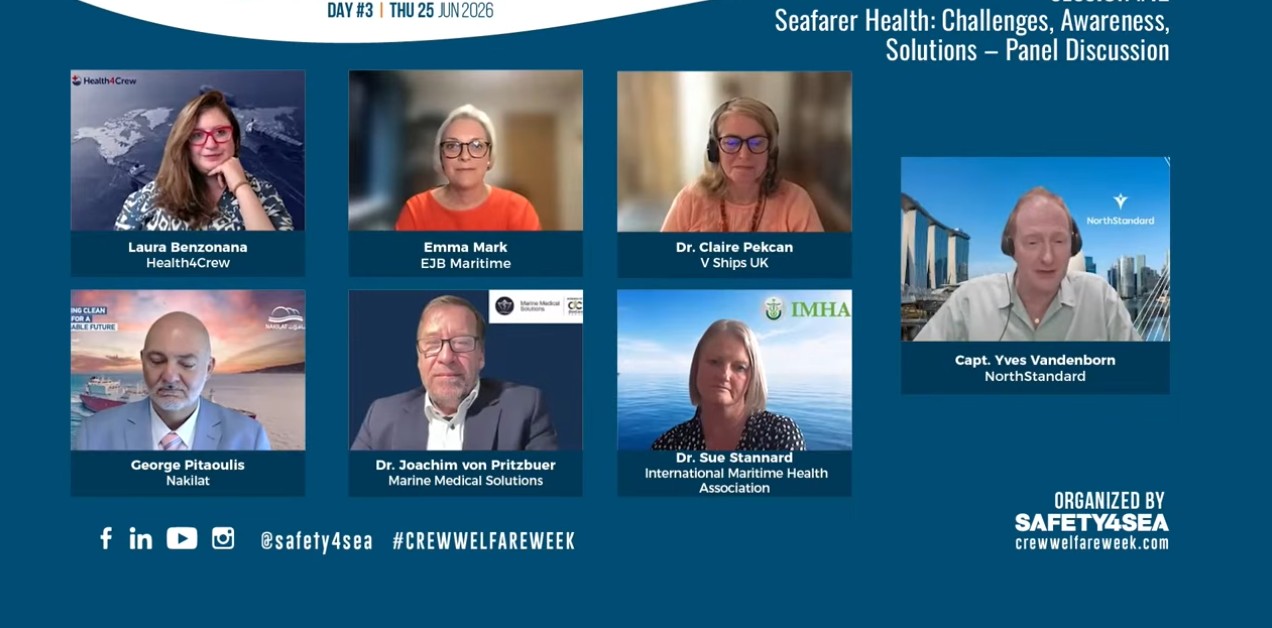
Moderated by Capt. Yves Vandenborn, FNI, Head of Loss Prevention Asia-Pacific, NorthStandard, the panel featured Laura Benzonana, Chief Operating Officer, Health4Crew; Emma Mark, Executive Coach & Maritime Retention Specialist, EJB Maritime; Dr. Claire Pekcan, Learning & Development Client Relationship Manager, V Ships UK Ltd; George Pitaoulis, Head of Marine Personnel, Nakilat; Dr. Joachim von Pritzbuer, Medical Director, Marine Medical Solutions; and Dr. Sue Stannard, President, International Maritime Health Association.
10 industry actions identified by the panel to advance preventative seafarer healthcare
#1 Treat health as a risk-management priority: Connect preventive healthcare with fewer incidents, fewer claims and more resilient operations.
#2 Integrate physical and mental health: Avoid separating medical care, psychological safety, fatigue management and workplace culture.
#3 Target chronic conditions early: Use medical and fleet data to identify obesity, hypertension, diabetes and other risks before they become emergencies.
#4 Share anonymised health data: Improve collaboration among owners, managers, P&I clubs, flag States and medical providers.
#5 Standardise data definitions: Develop consistent classification and reporting methods so that organisations can make meaningful comparisons.
#6 Measure the value of prevention: Track claims, repatriations, retention, medical trends and operational outcomes to demonstrate return on investment.
#7 Build psychologically safe reporting cultures: Ensure seafarers can disclose health and welfare concerns without judgement or professional repercussions.
#8 Educate leaders ashore and onboard: Give managers and officers the skills to recognise risks, respond appropriately and support early intervention.
#9 Improve medical consistency: Align pre-employment medical guidance and strengthen quality expectations for telemedical services.
#10 Assess decisions through a health lens: Consider the health and safety implications of manning, budgets, contracts and new technology before decisions are implemented
From crisis response to prevention
Opening the discussion, Capt. Vandenborn said shipping has traditionally treated seafarer health like an emergency room: responding when something goes wrong, applying a “clinical band-aid” and moving on.
The industry must instead develop a preventive, data-driven and sustainable model that keeps crews healthy before a crisis occurs.
Seafarer health isn’t just the absence of physical illness; It encompasses mental resilience, psychological safety, financial security and freedom from workplace harassment.
…he said.
Health should therefore no longer be seen as a nice-to-have benefit but as a requirement for safe and effective ship operations.
Benzonana reinforced the need for an integrated approach.
“We do not separate mental health from physical health. Health is one thing, and we look at it as a complete holistic picture,” she said.
Combining medical examinations, telemedicine, mental health support and ongoing monitoring can help companies move from generalised wellness campaigns towards targeted interventions based on the actual needs of their crews.
Chronic conditions require targeted support
Obesity, hypertension, diabetes, cardiovascular illness, dental problems and musculoskeletal conditions were among the recurring risks identified by the panel.
Dr. von Pritzbuer said a review of 1,000 medical cases found that most were not caused by accidents. Back and shoulder pain, dental concerns, kidney stones and cardiac problems represented a significant proportion of cases requiring treatment.
Benzonana highlighted the growing burden of lifestyle-related disease. In a recent sample of seafarers from different populations, 65% were classified as overweight or obese, although the figures varied between cultures.
Medicine has gone into a personalised model. We don’t treat illnesses; we treat the patient. Why are we doing something differently onboard?
…she said.
A single wellness programme cannot address the needs of every fleet, nationality or individual. Companies need to examine trends, compare data and develop targeted support before chronic conditions become operational problems.
Dr. Stannard noted that many of the same conditions appear repeatedly in medical, telemedical and repatriation data.
“You see them year after year after year, so obviously we are not having the impact that we would hope to have,” she said.
Fatigue is a multiplying risk
Fatigue was also identified as a major concern, particularly because its role may not be obvious in incident statistics.
Dr. Pekcan explained that although fatigue may be recorded as the direct cause in relatively few incidents, it can contribute to poor judgement, reduced concentration and other errors.
“When we look at it as a risk factor and its multiplying effect, the underlying cause of around 25% of our incidents is fatigue-related,” she said.
Sleep patterns and fatigue risks also vary across sectors and ranks. Junior officers on leisure vessels and senior officers on cargo ships may face different pressures, reinforcing the need for sector-specific analysis rather than a standardised response.
Dr. von Pritzbuer identified shorter contracts and more sleep as the two changes he would most like the industry to make.
Data exists, but sharing remains limited
The panel agreed that shipping does not necessarily suffer from a lack of health data. The greater problem is that information is scattered across medical providers, employers, insurers, flag States, welfare organisations and research bodies.
“There is a lot of data out there,” Dr. Stannard said. “What is lacking is the sharing of that data and therefore working across the industry.”
Different collection methods, classification systems and definitions make direct comparisons difficult. Commercial sensitivity and data-protection requirements present further barriers, but anonymised findings could still be published, discussed and used to improve practice.
“We need to get better at sharing that data and learning from each other first and foremost,” she added.
Benzonana said fleet data can be used to identify chronic health trends and create programmes tailored to specific companies and seafarer populations.
“We’re not there to monitor them; we are there to support them,” she stressed.
Trust is essential. Seafarers need to understand why information is being collected, how it will be protected and how it will be used to support their health rather than penalise them.
Proving the return on investment
The panel explored how companies can demonstrate that preventive healthcare is an investment rather than a cost centre.
Pitaoulis said the answer depends partly on how employers view their people.
“Cost centre or investment?” he asked. “We say to our people that they are effectively our ambassadors. The end user of the cargo does not see us in the office; they see our vessel and our people.”
Mark offered a direct commercial example. Training a cadet represents a substantial financial commitment. When a poor first experience causes that cadet to leave the industry, both the investment and the future talent are lost.
“If shipowners and companies don’t see that protecting that investment through wellbeing initiatives and looking after people matters, then you are literally losing money,” she said.
However, the panel acknowledged that precise return-on-investment figures remain difficult to establish. Companies often collect information about their own programmes, while P&I clubs primarily see cases in which something has gone wrong.
Benzonana called for a more collaborative approach.
“We need to share our data so that we can actually prove there is a return on investment,” she said.
Capt. Vandenborn noted that enhanced pre-employment medical examinations appear to be associated with fewer illness claims, while mental wellbeing initiatives can strengthen social cohesion and reduce incidents. However, the industry cannot yet confidently promise a specific percentage return from a particular intervention.
Psychological safety determines whether people speak
Health policies are ineffective when seafarers do not feel safe reporting illness, fatigue, burnout, harassment or other concerns.
“The barrier is rarely awareness,” Mark said. “Most of us know when something isn’t right. The challenge is whether you feel safe enough to speak up.”
A just culture is determined not by what a policy says, but by what happens after someone raises a concern. Crew members watch how colleagues are treated, whether action follows and whether reporting affects future opportunities.
People judge an organisation less by its policies and more by what happened to the last person who raised a concern,
…she added.
Pitaoulis noted that seafarers may be more concerned about how vulnerability will be perceived by their onboard peers than by shore management.
“They live with their peers onboard,” he said. “That has a much longer effect on how they are perceived than an employer who is thousands of miles away.”
Leadership education is therefore essential, both onboard and ashore. Officers must be able to recognise concerns, respond appropriately and create an environment in which people can seek assistance early.
The master’s confidentiality dilemma
Medical communication presents a difficult balance between confidentiality and the master’s legal responsibility for those onboard.
Benzonana explained that serious medical cases and telemedical consultations continue to involve the master. Preventive advice may be delivered directly to individuals, but the master must be informed when a condition affects treatment or vessel safety.
Pitaoulis summarised the legal tension directly:
“You cannot be liable for something and not be aware of it.”
Dr. Stannard agreed that some confidential information may need to be shared to provide appropriate treatment and protect safety. However, all parties have a duty to ensure that personal data go no further than necessary.
Benzonana described the situation as a “catch-22”: the industry encourages seafarers to seek help, but access to telemedical assistance may still require them to approach the master first. This may discourage reporting, particularly for concerns that initially appear minor or sensitive.
Consistency and quality must improve
The discussion also highlighted variation in pre-employment medical requirements and telemedical services.
Dr. Stannard called for more consistent medical guidelines across flag States, P&I clubs and shipping companies. A medical condition should not automatically end a seafaring career if it can be safely and appropriately managed.
“You can still be healthy with a medical condition,” she said.
She also called for better training for telemedical doctors. Clinical competence alone may not prepare a doctor to provide remote advice to a vessel.
“Do they understand the seafaring environment? Do they know what it is like onboard, what equipment is available and what training seafarers have had?” she asked.
The panel concluded that seafarer health is not a luxury or a bonus. It is a baseline requirement for safe, humane and resilient shipping.
As Dr. Stannard said:
We as an industry can invest in the time to collect the data, but also to share it, because only collectively can we move forward and make a difference.
Explore more by watching the video herebelow:
Content Original Link:
" target="_blank">