





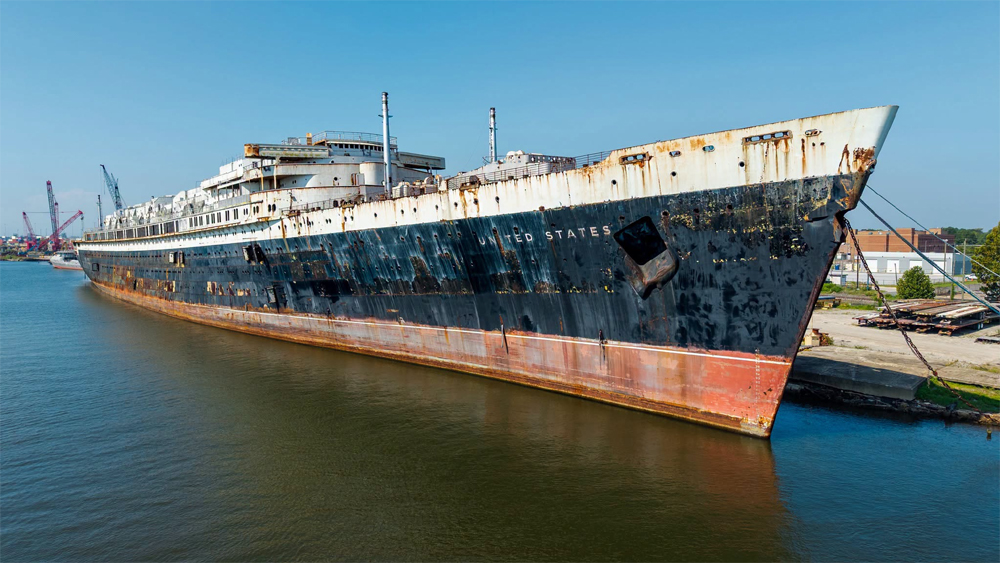
Lawsuit Seeks to Stop Planned Sinking of S.S. United States
The S.S. United States was removed from commercial service in 1969 and later sold to the U.S. Government. Starting in 1980, she went into private hands with a variety of plans to restore her to operation. The Conservancy was looking for a partner to develop the ship as a museum, tourist attraction, or possibly a hotel.
Okaloosa hired consultants to remediate the ship in preparation for its conversion into a reef. The efforts focused on removing elements such as the remaining electric wiring, fuel, and other toxic materials, as well as making the hull safe for divers.
The suit, however, alleges that the U.S. Army Corps of Engineers approved the project without adequately examining environmental risks or complying with historic preservation requirements. The complaint asks the court to set aside the Army Corps’ permit modification and finding of no significant impact, and to bar the tow and sinking until the Army Corps complies with the National Environmental Policy Act and the National Historic Preservation Act.
It alleges that the Army Corps approved the project without preparing an environmental impact statement. It also alleges that the Army Corps failed to complete a required historic preservation review. It also highlights that the preparation project undertook “anticipatory demolition,” without the approval for the reefing project.
At issue is the use of hexavalent chromium in the early 1950s in the primer for the steel surfaces of the ship. The nonprofit asserts that laboratory testing identified hexavalent chromium in sampled coatings aboard the vessel and cites University of Florida’s Dr. Todd Osborne, who warned of potential harm to marine organisms, sediments, and the food web, as the chemical breaks down in water. Okaloosa has in the past asserted that it breaks down to a less harmful chemical. The Army Corps predicted minimal adverse effects despite uncertainty about contaminant quantities and release rates, according to the Foundation.
The Foundation estimates in its complaint that about 59,000 pounds of zinc chromate was applied as the primer during construction based on historical painting specifications and modeled surface area for the vessel. The Foundation is calling for further sampling and environmental assessment before sinking the vessel.
The suit is also challenging the mandated “Section 106” review. It is a key provision of the National Historic Preservation Act of 1966 (NHPA) that requires federal agencies to consider the impact of their federally funded, licensed, or permitted projects on historic and cultural properties.
The Foundation emphasizes the historical significance of the vessel, noting that it was listed in 1999 on the National Register of Historic Places. It says that the S.S. United States was described by National Park Service historian Patrick Andrus as “exceptionally important for engineering for its hull design and propulsion system.”
It also cites that the ship’s funnels, radar mast, last propeller, and portholes and windows were all removed during the remediation process.
On Friday, Judge M. Casey Rodgers of the U.S. District Court, Northern District of Florida Pensacola Division denied without prejudice the Emergency Motion for a Temporary Restraining Order. The judge wrote that the docket lacked a verified complaint and/or any affidavit attesting to the truthfulness of the facts. In addition, the judge said the plaintiffs were requesting the court to wave or set a minimal security bond, while noting the likely high berthing, mooring, docking, storing, etc. expenses for the S.S. United States. The court instructed that any subsequent motion must propose a bond amount sufficient to cover these expenses.
The Foundation refiled with an amended Emergency Moition later on Friday.

that matters most
Get the latest maritime news delivered to your inbox daily.
The current plan calls for the hull of the liner to be towed from Mobile, Alabama on November 9. Weather permitting, the sinking is scheduled for November 12 in the Gulf.
Okaloosa County has said it continues to move forward with the project. It has not commented on the suit and told local media on Thursday that it had not yet been served in the case. The Army Corps has not commented. The Foundation's lawyers included in the new filing details of the notice and reports, counsel for Okaloosa County, returned counsel’s call, indicating that the County opposes a temporary restraining order and a preliminary injunction.
Content Original Link:
" target="_blank">