




The Mærsk Mc-Kinney Møller Center for Zero Carbon Shipping (MMMCZCS) has highlighted the importance of balancing regulatory certainty and flexibility
The Mærsk Mc-Kinney Møller Center for Zero Carbon Shipping (MMMCZCS) has highlighted the importance of balancing regulatory certainty and flexibility as IMO Member States negotiate future emissions targets.
In its latest Countdown analysis, Balancing flexibility and certainty in IMO target-setting, the Center examines how different proposals for the IMO Net-Zero Framework could affect investment in low-emission marine fuels, ships and supporting infrastructure.
The analysis comes ahead of the next IMO negotiations, beginning with the Intersessional Working Group on Greenhouse Gases (ISWG-GHG 23) on November 23, 2026, followed by the Marine Environment Protection Committee (MEPC 85) in early December.
According to MMMCZCS, one of the central issues facing IMO Member States is how to establish greenhouse gas (GHG) fuel intensity targets that provide sufficient certainty for long-term investment while retaining flexibility to respond to changing market conditions.
The Center argues that predetermined annual emissions targets extending through at least 2040, combined with a narrowly defined review mechanism, could provide a stronger investment signal for the transition to low-emission shipping.
Different approaches to emissions targets
The analysis identifies three main areas of difference among proposals currently under consideration: how emissions targets are determined, how far into the future they extend and the extent to which they can be revised.
Most proposals follow the approach of the draft IMO Net-Zero Framework, establishing fixed GHG fuel intensity targets intended to support the development of low-emission fuel supply chains and progress toward net-zero emissions by or around 2050.
However, Liberia has proposed linking targets to assessments of commercially viable fuels, taking into account affordability, availability and scalability. Japan and South Korea have proposed approaches combining fixed targets with elements dependent on commercial viability.
Japan’s proposal establishes fixed targets through 2035, with subsequent targets determined according to commercial viability. South Korea proposes fixed Tier 1 targets while linking Tier 2 targets to commercial viability.
The proposals also differ in their time horizons. While some establish requirements through 2035 or 2040, others extend to 2041 or provide for a longer trajectory subject to periodic reassessment.
MMMCZCS notes that these differences could have significant consequences for investment decisions across the shipping and energy sectors.
Investment certainty versus regulatory flexibility
According to the Center, shipping companies, fuel producers, ports and project financiers require confidence in future regulatory requirements before committing to large-scale investments.
Ships, fuel production facilities and port infrastructure typically have operating lives of 20–30 years or longer. Establishing annual emissions targets through at least 2040 would therefore provide greater visibility over a meaningful part of their operational lifetimes.
The Center argues that predictable requirements can encourage earlier investment in low-emission technologies and fuel production, potentially reducing the overall cost of the transition.
However, greater certainty also limits policymakers’ ability to adjust regulations if fuel availability, compliance costs or other market conditions develop differently than expected.
Conversely, more flexible target-setting could allow regulators to respond to changing circumstances but may weaken investment incentives.
MMMCZCS warns that linking emissions targets too closely to the current commercial availability of alternative fuels could create a self-reinforcing problem. If limited fuel supply leads to weaker targets, the resulting reduction in regulatory demand could discourage investment in additional production capacity.
The analysis also identifies potential consequences including delayed fuel supply agreements, slower technological innovation and continued dependence on conventional marine fuels.
Lessons from previous fuel regulations
To illustrate the relationship between regulatory certainty and investment, MMMCZCS examines two previous regulatory frameworks: the IMO 2020 global sulfur cap and the US Renewable Fuel Standard.
The IMO’s 0.50% global sulfur limit was established with a provision allowing a review of whether implementation should be postponed from 2020 to 2025.
Although concerns remained about the availability of compliant fuel, the IMO ultimately retained the January 2020 implementation date.
According to MMMCZCS, the uncertainty surrounding the possible postponement affected preparation and investment decisions. Once the implementation date was confirmed, the industry accelerated changes to fuel supply arrangements and investments in compliance technologies.
The Center contrasts this experience with the US Renewable Fuel Standard, which allows renewable fuel requirements to be reduced when supply is considered insufficient.
Its analysis suggests that repeated reductions in fuel requirements have weakened investment incentives, particularly for advanced biofuels whose production capacity was expected to expand in response to regulatory demand.
MMMCZCS argues that these examples demonstrate the importance of designing review mechanisms that allow necessary adjustments without undermining confidence in long-term targets.
Options for reviewing IMO emissions targets
The analysis also examines how future reviews of the IMO Net-Zero Framework could balance flexibility with predictable emissions requirements.
The draft framework includes a five-year review mechanism, but proposals differ over whether reviews should be limited to specific regulatory elements or allow broader changes to emissions targets.
MMMCZCS identifies three possible approaches:
- Adjust supporting mechanisms: Reviews could focus on measures such as zero- and near-zero emission fuel rewards or banking arrangements, without reopening the overall emissions reduction trajectory.
- Allow a limited postponement: A review could permit the 2040 target to be delayed by a maximum of two years, while preserving the target itself.
- Introduce a no-backsliding provision: Regulations could be tightened when justified by market developments, but not weakened below previously established requirements.
The Center considers narrowly defined reviews preferable to open-ended mechanisms that could substantially alter the agreed emissions pathway.
It emphasizes that fixed targets would not prevent future regulatory changes, but including them in MARPOL provisions would make revisions more difficult and provide a stronger signal to investors.
Upcoming IMO negotiations
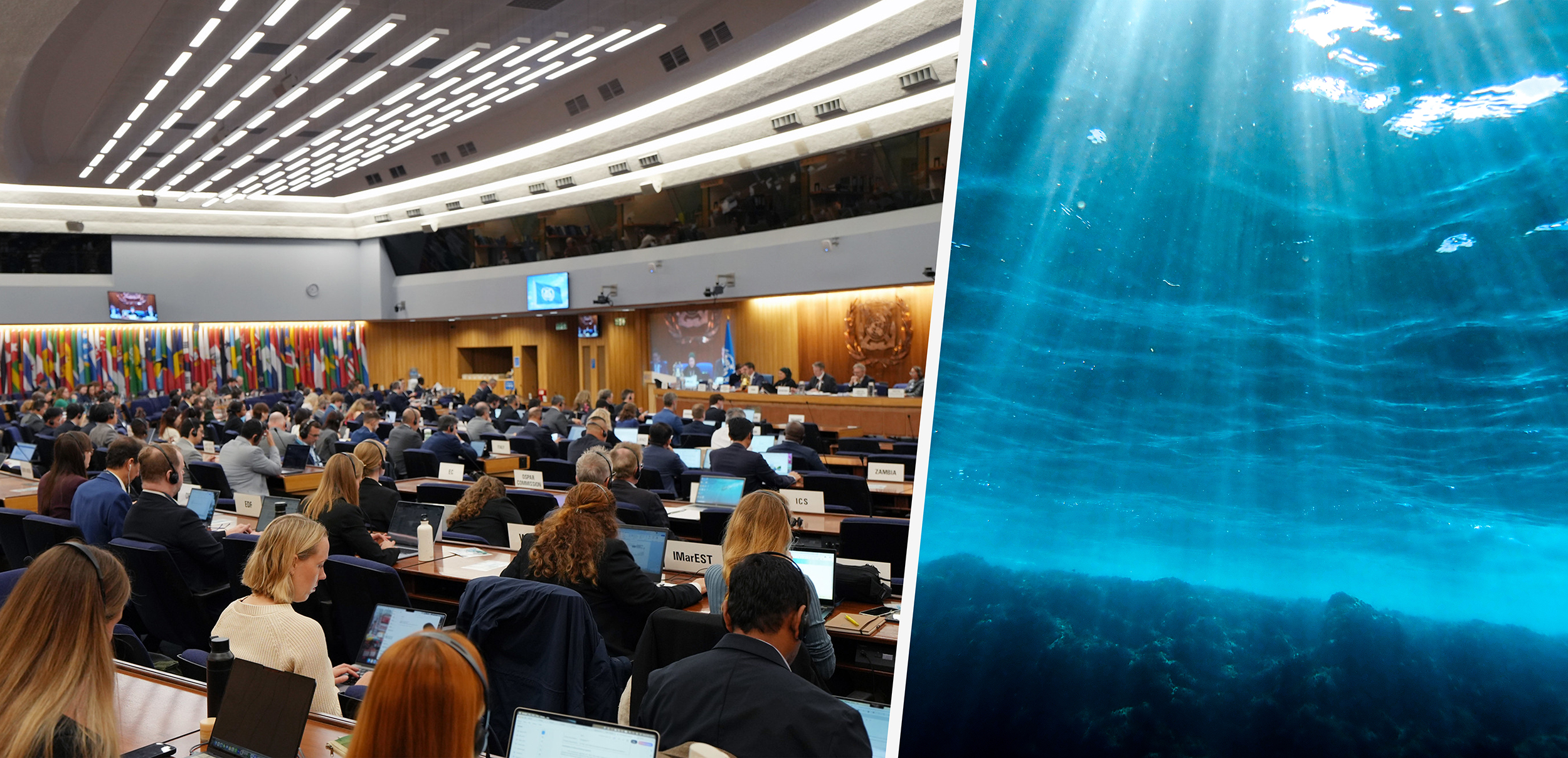
IMO Member States are expected to continue discussions on the emissions reduction framework at ISWG-GHG 23, beginning November 23, followed by MEPC 85 in early December. The negotiations will address remaining differences over the design of the framework, including emissions targets, compliance mechanisms and the balance between regulatory ambition and commercial feasibility.
MMMCZCS notes that an agreement could potentially be reached during MEPC 85, with formal adoption occurring at that meeting or during a subsequent session in 2027.
The Center maintains that predictable long-term targets, supported by carefully defined review provisions, would help create the conditions for investment in low-emission fuels and technologies.
We are encouraged by the renewed spirit of engagement among Member States and urge them to build on this momentum in finding a solution that lives up to the ambition of 2023 IMO GHG Strategy and delivers the certainty that industry and investors are seeking. Crucially, that means a clear, enforceable emissions trajectory that creates a level playing field and contributes to a just and equitable transition […]
…said Bo Cerup-Simonsen, Chief Executive Officer, Mærsk Mc-Kinney Møller Center for Zero Carbon Shipping.
Content Original Link:
" target="_blank">